

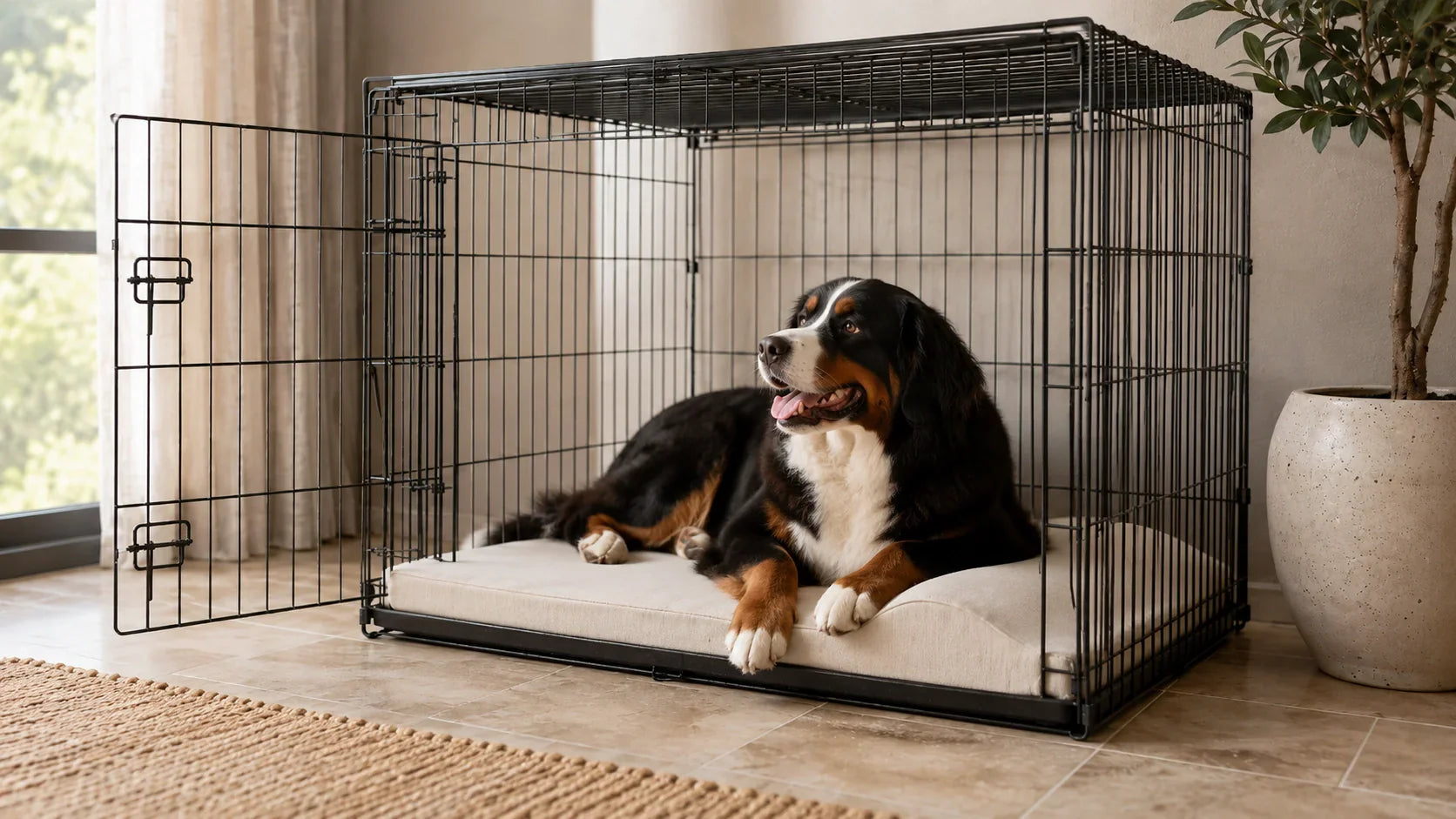
A crate can feel like a safe corner, a nap spot, and a training tool. A poor pad can make it feel hard, hot, noisy, or hard to clean. A waterproof dog crate pad should protect against accidents without turning the crate into a sticky plastic box. A dog crate mattress should also support the body, fit the crate, and stay easy to refresh after real puppy life.
Quick Takeaway
- A crate pad should fit the crate without blocking movement.
- Waterproof protection helps with accidents, but breathability still matters.
- No crate pad should be called truly indestructible for every chewer.
- Large dogs need support that resists flattening in a limited space.
- Washable layers make crate care easier after leaks, drool, and dirt.
- Comfort can support crate training, but training still depends on positive habits.
Can the Wrong Crate Pad Make Crate Training Harder?
Yes. The pad cannot train the dog, but it affects how the dog experiences the crate every day.
AKC describes a dog's crate as a personal den and advises building positive associations rather than making it feel like punishment (American Kennel Club, 2026). A floor that feels hard, loud, or hot works against that.
Puppies are also learning bladder control and how to be alone, and they can’t control their bladder until they’re about 16 weeks old (AKC, 2025). A pad that slips, holds odor, or takes too long to clean after an accident makes crate time harder for both dog and owner.
What a Crate Pad Should Do
A good dog crate mattress should:
- Provide a steady place to lie down
- Fit without curling up at the edges
- Stay quiet when paws move
- Avoid heavy heat buildup
- Handle routine washing
- Dry fully before the next use
- Leave enough room to turn and rest
A well-chosen crate pad helps the crate feel cozy and restful, which is a key part of making it a space the dog wants to return to.
As animal behaviorist Alice Moon-Fanelli, PhD, CAAB, of Brooklyn Veterinary Hospital cautions that "proper introduction to crating greatly influences whether a dog not only accepts but is comfortable being crated" (PetMD, 2023).
Starting with the most basic requirement: fit.
Why Fit Matters

The pad should match both the crate and the dog.
For house-training, crates are kept small enough to discourage soiling. For older dogs, more room helps with repositioning. For elderly animals, a much larger crate is often preferred to give them room to move, stretch, and reposition.
- Too small: hard crate floor stays exposed
- Too large: pad curls, folds, or creates chewable edges
Waterproof vs Breathable
Most pads prioritize one over the other. The trade-off looks like this:
| Waterproof Focus | Breathable Focus | |
| Accident protection | Strong | Limited |
| Heat buildup risk | Higher | Lower |
| Odor after saturation | Higher | Lower |
| Best for | Accident-prone dogs | Warmer climates, heavy coats |
Crate fans can help during warmer months or for heavy-coated animals, and that crate covers can cause heat buildup without supervision.
The better answer is a pad that does both: waterproof protection at the cover layer, and an open-fiber core that lets air move through.
Can Waterproof Crate Pads Cause Skin Irritation?
Not directly. But a damp, warm, poorly ventilated surface can make rest less comfortable over time.
"Waterproof" does not automatically mean comfortable. Some waterproof surfaces feel slick, noisy, or warm. Skin irritation has many causes: allergies, parasites, infection, or moisture.
A crate pad should not be blamed for every rash. The signs below help identify whether the pad is contributing.
A Better Waterproof Standard
The best pad is not only liquid-resistant. It should also be easy to clean and comfortable enough for daily rest.
If your dog has accidents, the pad should let you remove the cover, rinse washable parts, and dry everything fully. Avoid heavy fragrance as the main odor solution. Dogs rest with their noses close to the pad.
Why Does Support Matter for Large Dogs in Crates?

Large dogs in crates have less room to shift. If the pad is too thin, elbows and hips press into the crate tray. If too soft, the dog sinks and works harder to stand.
An orthopedic crate pad for large dogs should spread weight across the surface and keep bony points off the floor.
Pressure in a Smaller Space
A crate limits motion by design. For large dogs, the pad becomes the main contact point for long naps and overnight rest.
Support should feel steady, not stiff.
- Too hard: easy to clean, but dogs may not settle
- Too soft: traps heat, slides, or bunches under a circling dog
Size and Movement Checklist
Before choosing a crate pad, check:
- Can your dog stand in the crate?
- Can your dog lie down fully?
- Can your dog turn around without fighting the pad?
- Does the pad stay flat?
- Does the edge tempt chewing?
- Does the pad cover pressure areas without crowding the door?
For FURIZEN sizing, the Medium lists 36" x 23" x 6" for dogs 7-40 lbs, and Large is 48" x 30" x 6" for dogs 18-88 lbs. At 6" thick, this is a crate-fit bed, not a thin pad. Match size to the crate floor and your dog's actual dimensions.
How Should a Durable Crate Pad Handle Accidents and Digging?
Puppy accidents, muddy paws, drool, and digging are normal parts of crate life. No soft bed should be treated as chew-proof for every dog.
"Indestructible dog crate pad for chewers" is a common search phrase. PetMD quotes experts warning that some dogs chew and ingest bedding, while others settle into it. Know your dog and supervise new bedding.
What Accidents Require
After an accident, a crate pad needs practical care:
- Remove the dog from the crate.
- Take off the cover if removable.
- Blot liquid before it spreads.
- Wash the cover according to the care label.
- Clean the core only if the product allows it.
- Dry every layer before reuse.
Unwashed dog beds can harbor bacteria, allergens, and disease-causing organisms. One study found fleas in approximately 14% of pets' sleeping places, even outside prime flea season (Zanen et al., 2022).
If liquid reaches a foam core that cannot be washed, odor will linger. If the core can be rinsed, water drains out rather than soaking in.
Why Digging Happens
Digging can signal boredom, excess energy, nesting behavior, or stress. PetMD also notes that bedding destruction may stem from lack of exercise or proper enrichment before the dog goes into the crate (PetMD, 2023).
The fix is routine: exercise, enrichment, safe toys, and bedding matched to the dog's behavior.
What to Check After Crate Time
After your dog rests in the crate, look for:
- Dampness under the belly
- Redness on contact areas
- Strong odor near the pad
- Pawing, digging, or repeated repositioning
- Avoiding the crate after warm days
- Chewing at pad seams or corners
These signs do not diagnose a skin problem. They help you decide if the pad needs a different texture, better airflow, more cleaning, or a new size.
Crate Pad Comparison
| Crate Pad Type | Strength | Weakness | Best Use |
| Thin waterproof mat | Easy wipe-down | Limited support and warmth control | Short crate sessions, low-padding needs |
| Foam crate pad | Soft cushioning | Core may hold odor if liquid gets inside | Dogs that need soft comfort and low accident risk |
| Whole-core washable air-fiber crate pad | Rinseable support core with airflow | Needs drying time and proper care | Dogs needing support, odor control, and cleaner routines |
A heavy duty waterproof dog bed should be judged by behavior over time. Does it stay flat? Does it clean without odor returning? Does your dog rest calmly? Does it support the body without creating heat buildup?
Choose a Cleaner Crate Pad for Everyday Comfort
The FURIZEN Zenest Ridge™ Washable Orthopedic Dog Bed is a calmer alternative for crates and rooms that need comfort without clutter. Its ZephyrTech™ air-fiber core supports airflow, rinses clean when needed, and lets water drain instead of soaking in.
Giving you less fuss and more bond, it includes a 100-Night Sleep Trial and a 10-Year Bounce-Back Warranty on the ZephyrTech™ air-fiber core.
FAQs
Q1: Can a washable crate pad handle puppy accidents?
Yes, if the care instructions allow deeper cleaning. A removable cover helps with surface mess, while a washable core can help when liquid reaches deeper layers. Dry all parts fully before crate use.
Q2: Is any dog crate pad truly indestructible?
No. A determined chewer can damage many soft materials. Choose durable, chew-aware bedding, supervise new pads, and remove bedding if your dog chews or swallows pieces.
Q3: How do I choose the right crate pad size?
Match the pad to the crate floor and your dog's movement. Your dog should be able to stand, lie down, and turn around without the pad folding, curling, or blocking the crate door.
Q4: Should a crate pad be waterproof or breathable?
It should balance both. Waterproof protection helps with accidents, while breathability helps reduce heat and dampness. For daily crate rest, choose cleanable layers that do not make the crate feel warm or sticky.
Sources
- American Kennel Club. (2026). How to Crate Train Your Dog: Expert Tips for Every Age. https://www.akc.org/expert-advice/training/crate-training/
- American Kennel Club. (2025). Why Does My Puppy Pee in the House? https://www.akc.org/expert-advice/puppy-information/why-does-my-puppy-keep-peeing-in-the-house/
- Zanen, L.A., Kusters, J.G., & Overgaauw, P.A.M. (2022). Zoonotic Risks of Sleeping with Pets. Pathogens. https://pmc.ncbi.nlm.nih.gov/articles/PMC9606909/
- Higgs, V., DVM. (2023). How to Make Your Dog's Crate Feel Like Home. PetMD. https://www.petmd.com/dog/care/how-make-your-dogs-crate-feel-home
Share:
Why Every Dog Owner Needs an Odor Resistant Dog Bed for a Fresher Home
How to Keep Large Dogs Cool in Summer (Golden Retriever, German Shepherd, and More)