

At a Glance: Does My Dog Need a Bed?
| Your Dog's Profile | Floor OK? | Bed Recommended? |
| Under 5 years, under 25 lbs, healthy joints | Acceptable short-term | Beneficial, not urgent |
| Over 50 lbs | Not recommended | Yes |
| Age 7 or older | Not recommended | Strongly recommended |
| Joint issues, hip dysplasia, or surgery history | No | Yes (consult your vet) |
| Short coat, lean build, warm room (68°F+) | Neutral in warm months | Still useful for structure |
| Consistently avoids their current bed | Likely a bed problem | Re-evaluate the bed first |
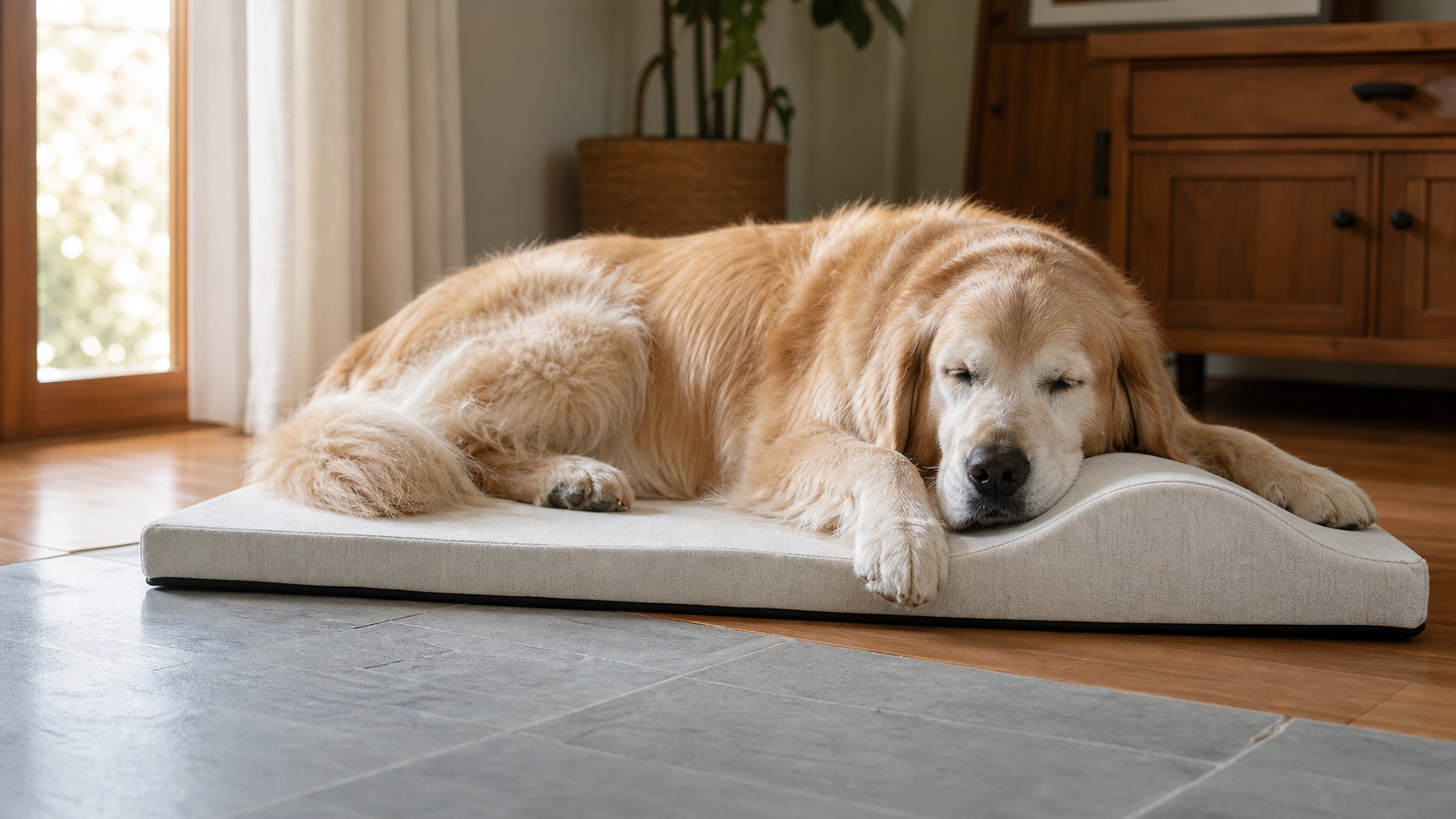
Your dog keeps choosing the tile floor, the hardwood, sometimes the bathroom corner. They look comfortable, and you start to wonder if that bed is collecting dust for a reason.
Well, the truth is that the floor is fine in certain situations. But "fine" and "actually good for your dog's body" are never the same thing. Here's how to read what your dog's sleeping habits are actually telling you, and how to decide whether your dog needs a dog bed.
What the Floor Does to Your Dog's Body Over Time?
The floor is not inherently harmful. It creates four specific, measurable effects on your dog's body, and all four compound over time.
It Compresses the Same Joints, Every Day
Hard floors concentrate body weight at hip bones, shoulder joints, elbows, and knees. Adult dogs can sleep 8 to 13.5 hours a day (Sleep Foundation, 2025), creating hundreds of compression cycles against those same points, every day, for years.
It Pulls Body Heat Away During Sleep
Tile and concrete are significantly better heat conductors than foam-based mattress materials. In a cooled room, this ongoing heat loss triggers frequent position shifts and interrupts deep sleep. Senior dogs, whose ability to regulate body temperature declines with age, are especially affected.
It Fragments Your Dog's Deep Sleep
When floor contact creates discomfort, dogs shift positions repeatedly rather than cycling through full rest. Fragmented sleep reduces time spent in deep recovery phases, affecting both muscle repair and stress regulation.
It Stiffens Muscles After Sleep
Cold, hard surfaces cause muscles and connective tissue to tighten during sleep. Dogs sleeping on hard floors frequently show slower, stiffer movement in the first minutes after waking up, particularly in cold or air-conditioned environments.
When the Floor Is Actually Fine (and When It's Not)?
When the Floor Causes No Real Problem
1. Young, Small Dogs
Joint cartilage is at full health, body weight is low, and the compression effect takes years to accumulate. If your dog rises smoothly and does not shift positions constantly, short-term floor time carries low risk.
2. Lean Dogs in Warm Rooms
When room temperature stays above 68°F and the floor is not marble or concrete, a dog that runs warm may genuinely benefit from the cooling contact. The floor's thermal conductivity is working in the dog's favor.
3. Occasional Floor Use
Dogs naturally move between surfaces throughout the day as part of normal thermoregulation. Choosing the floor sometimes is not a problem. Choosing it consistently over a bed is a different pattern worth paying attention to.
When the Floor Starts Costing Your Dog
1. Dogs Over 50 lbs
Body weight concentrates heavily at joint contact points. The larger the dog, the higher the load on cartilage with every hour of sleep.
2. Senior Dogs
Cartilage wear is already present and progressing, with research showing that acquired cartilage degeneration is prevalent in adult large breed dogs and increases significantly with age (Craig et al., 2013).
Hard surfaces accelerate this process in ways that a younger dog's joints could still absorb.
3. Dogs with Joint Issues
Floor contact directly worsens existing inflammation. These dogs have the least tolerance for pressure during rest.
4. Cold or AC Rooms
Ongoing heat loss through the floor disrupts deep sleep and slows muscle recovery overnight.
The floor is not the solution in these cases. The bed setup needs to change.
A Note on Dogs Avoiding Their Bed
The bed itself may be failing. A dog that reliably chooses the floor over a bed is not expressing a preference for hardness. The bed has typically lost structural support, is positioned poorly, or traps heat during sleep.

What a Good Dog Bed Actually Does for Your Dog?
A good bed needs more than softness. There are five specific things a properly designed bed does that the floor cannot.
It Spreads Load, Not Softness
The goal is even weight distribution across the body's contact surface. A too-soft bed causes the dog to sink and creates new pressure points. The right bed conforms while resisting.
It Regulates Temperature from Below
A bed insulates against floor heat loss in winter and, if air-permeable, prevents heat buildup in summer. Solid foam traps heat; open-fiber structures let air move continuously through the surface.
It Prevents Calluses and Pressure Sores
Repeated pressure against hard floors causes thickened skin and, in larger dogs, fluid-filled swellings (known as hygromas) on bony prominences like elbows.
A cushioned surface eliminates the contact friction that drives this process.
It Supports Muscle Recovery Overnight
Muscles repair during deep, uninterrupted sleep. A surface that maintains consistent comfort without triggering position shifts allows your dog to complete more full rest cycles each night.
It Gives Your Dog a Territory to Own
A fixed, scented sleep space reduces ambient anxiety and shortens time to sleep onset. A dedicated bed serves as this personal oasis, reducing anxiety and helping them settle faster.
How to Choose a Dog Bed That Functions Well?
Here are six things to check before you buy a dog bed.
Step 1: Measure Your Dog First
Measure from nose to tail base and add roughly 30%. That is your minimum bed length.
Step 2: Match the Shape to How Your Dog Sleeps
For dogs that curl up, look for a raised bolster or side wall. For dogs that sprawl, choose a flat, open surface with room for all four legs.
Step 3: Test Core Support Before Buying
Press the center firmly with your palm and release. If it does not spring back, skip it. For foam beds, ask for the stated lifespan or structural warranty before committing.
Step 4: Look for Airflow, Not "Cooling"
Choose open fiber construction over gel layers. A quick test: check how long the insert takes to dry after washing. If your dog settles on the bed and migrates off after a few minutes, heat buildup is the likely cause.
Step 5: Confirm It Is Actually Washable
Pull off the cover and confirm it goes straight into a machine wash. Check that the insert can be rinsed by hand and air-dried without extra steps.
Step 6: Pick the Spot Before the Bed Arrives
Choose a fixed, quiet corner away from foot traffic. Put the bed there and keep it there.

Give Your Dog's Sleep What It Needs
For most dogs, sleeping on the floor is perfectly fine in the short term. But for large breeds, senior dogs, or those with joint sensitivity, it can slowly take a toll on their comfort and joint health over time.
If that sounds like your dog, the Zenest Ridge™ Orthopedic Dog Bed from Furizen is worth considering.
The Zenest Ridge™ is a calmer alternative to beds that compress, overheat, or lose shape over time. Its ZephyrTech™ air-fiber core is designed to maintain support under daily use, while allowing continuous airflow through the surface, helping to regulate temperature and reduce pressure on joints. We built this bed to give your beloved pet the comfortable, supportive rest they deserve.
Ready to give your dog the rest they deserve?
Shop the Zenest Ridge™ Orthopedic Dog Bed today with our 100-Night Sleep Trial.
FAQs about dog sleeping surface choices
Q1: My dog always chooses the floor over their bed. What does that mean?
Check three things in order: press the bed center and release. If it does not spring back, support has failed. If support is fine, check placement: noisy or bright spots consistently lose to quiet floor corners. If both check out, heat buildup is the likely cause.
Q2: Is it okay for dogs to share a human bed instead of having their own?
It is not ideal as a primary sleep surface. Human mattresses are too soft for dog body mechanics and create uneven pressure points. Human movement at night also continuously fragments a dog's sleep, which needs up to 13.5 hours of rest daily to fully support recovery.
Q3: How do I get my dog to actually use the bed I bought?
Place the bed where your dog already tends to rest and add a worn piece of clothing for familiar scent. At natural rest times, use a treat to guide your dog onto the bed. Keep the location fixed. Most dogs adapt within one to two weeks.
Q4: Does flooring type matter? Is carpet better than hardwood for dogs?
Carpet distributes pressure better than hardwood and provides more cushioning, but still accumulates bacteria and lacks uniform support. Hardwood creates direct pressure-point risk. Tile conducts the most heat: useful in summer, problematic in cold environments. None of these fully replaces a purpose-built sleep surface.
Sources
-
Sleep Foundation. How Much Sleep Your Dog Needs. Sleep Foundation.
https://www.sleepfoundation.org/animals-and-sleep/how-much-do-dogs-sleep -
Craig et al. (2013). Age-associated cartilage degeneration of the canine humeral head. Veterinary Pathology.
https://pubmed.ncbi.nlm.nih.gov/22773468/ -
Nandini Maharaj. (2025). What to Know About Hygromas in Dogs. American Kennel Club.
https://www.akc.org/expert-advice/health/hygromas-in-dogs/
Share:
Why Your Dog's Bed Smells and What You Can Do About It
The Best Dog Bed for a Crate: Sizing, Fit, and Washability