

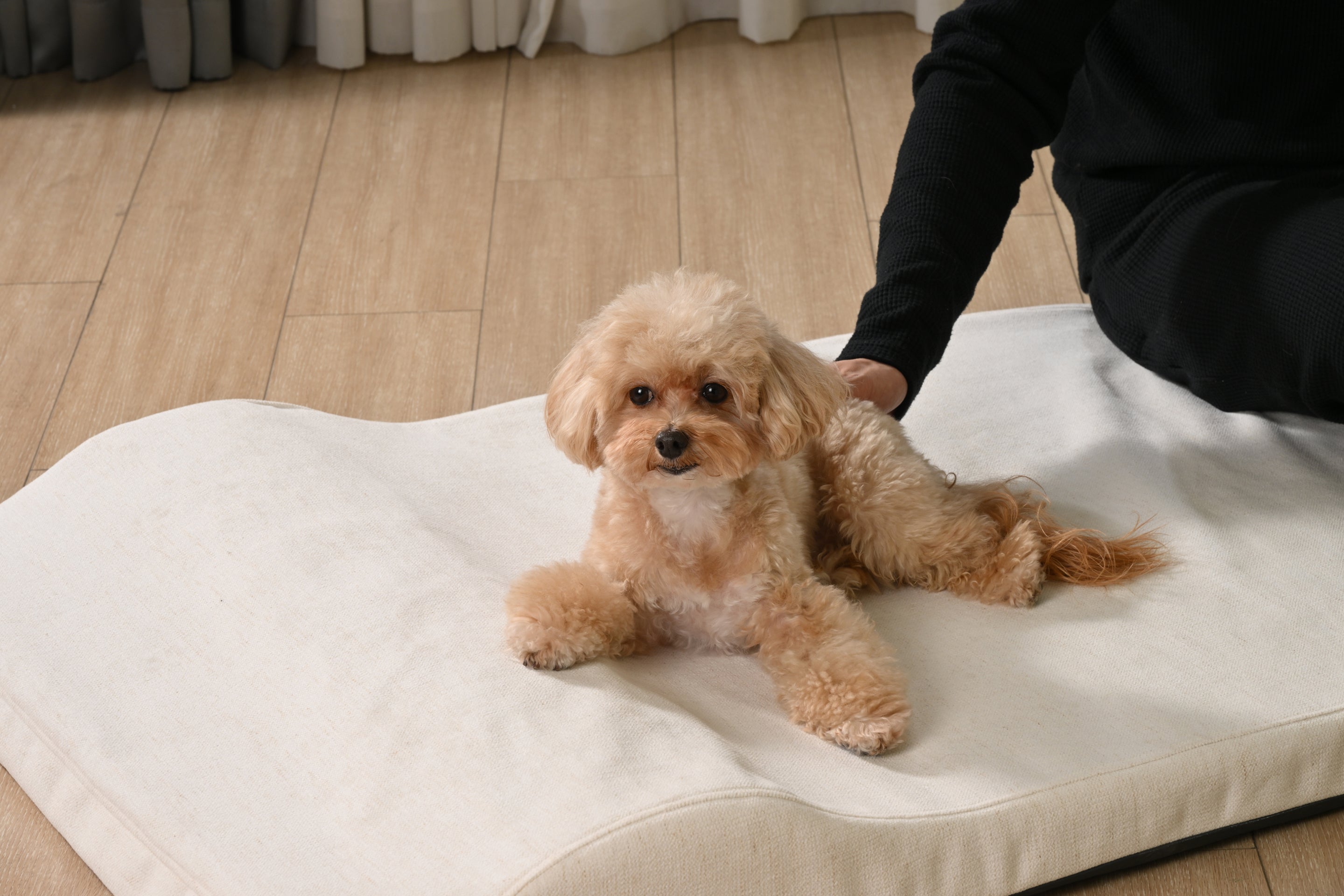
Dogs sleep 12 to 18 hours a day. Most owners know that. But sleeping a long time and sleeping well are two entirely different things. Humans spent decades learning that sleep duration tells only part of the story. For dogs, that awareness is arriving even later. Here is what genuinely good sleep looks like for your dog, and the quiet daily signals that suggest something is off.
Quick Look: Is Your Dog Sleeping Well?
| Signal | Healthy Sleep | Worth Watching |
| Rising from bed | Smooth, fluid in one motion | Hesitates, pushes up one side first |
| Morning stretch | Full, spontaneous | Skips it or moves stiffly |
| Sleep position | Stays settled in one spot | Circles, shifts, resettles repeatedly |
| Post-sleep mood | Calm, quietly curious | Groggy, flat, or irritable |
| Daytime energy | Active when up, fully rested when down | Half-asleep all day |
| Bed preference | Uses their own bed | Consistently drifts to cool floor tiles |
How Much Sleep Dogs Actually Need and Why It Matters
Most people know that dogs sleep a lot. Fewer stop to consider what that sleep is actually doing.
Sleep Needs by Age and Size
| Life Stage | Typical Daily Sleep |
| Adult dogs | 12–14 hours |
| Puppies | Up to 18–20 hours |
| Senior dogs | Up to 18–20 hours |
| Large breeds | Tend toward the higher end of their range |
None of this is laziness. It reflects real physiological demand. A dog's body uses sleep to accomplish things that waking hours simply cannot.
Four Core Functions Sleep Serves
Muscle and joint repair.
During deep sleep, the body releases growth hormone that supports cartilage repair and muscle recovery. For a dog sleeping 12 to 18 hours a day, the body spends the majority of its time in this restoration state. The surface the dog rests on directly affects how well that process runs.
Immune system maintenance.
Poor sleep suppresses immune function over time. Dogs with chronically low sleep quality get sick more easily and recover more slowly. The effect builds quietly in the background.
Emotional and behavioral stability.
Sleep-deprived dogs show elevated anxiety, lower frustration tolerance, and more frequent behavioral problems. Many traits that get labeled as "personality issues" are, at least partly, connected to sleep quality.
Memory and learning consolidation.
Research shows dogs process and lock in daytime learning during sleep. The training session from yesterday afternoon gets reinforced overnight, not in the moment.
A dog spends over half its life asleep. What happens during that time, including joint support, temperature regulation, and sleep continuity, has a long-term cumulative effect on health. It deserves real attention.
Signs Your Dog Is Actually Sleeping Well
Most owners recognize warning signs. Far fewer know what healthy sleep actually looks like. Here is a clear positive reference.
Signs of Good Sleep Right After Waking
- Rising smoothly, without hesitation. A well-rested dog stands in one continuous movement, all four limbs engaging together. Smooth rising indicates that joints received adequate support overnight. A dog that needs a moment to collect itself before completing the movement is showing you something worth noticing.
- A full, spontaneous stretch after waking. After quality sleep, dogs naturally extend into a complete stretch: front legs reaching forward as the chest drops low, or back legs pushing straight behind them. This happens without prompting. It reflects genuine muscular relaxation, a body that truly rested.
- Calm, present mood after waking. A well-rested dog wakes quietly alert and open to interaction, not frantic or unusually flat. Irritability, excessive excitement, or dull indifference after waking can all trace back to the quality of the sleep that came before.
Signs of Good Sleep Through the Rest of the Day
- Staying settled in one position. A dog sleeping well does not need to reposition frequently. Staying in one spot through a long rest means the surface is supportive enough that no pressure point becomes uncomfortable enough to trigger movement.
- A natural rhythm between activity and rest. Dogs with good sleep patterns are genuinely active when they are up, and genuinely at rest when they lie down. A dog hovering in a permanent half-awake state throughout the day is often compensating for poor overnight rest.
Signs Your Dog Might Not Be Sleeping as Well as You Think
These signals are the easiest to overlook, precisely because they look like ordinary dog behavior. Keep an eye out for any of these four patterns:
- Repeatedly shifting positions within a single sleep session
- Choosing the hard floor over their own bed
- Stiffness after rest, needing a few steps to move normally
- Sleeping long hours but still looking tired
Signs Your Dog Is Not Sleeping Well — During Rest
Repeatedly shifting positions during one sleep. Occasional rolling over is normal. A dog that circles, lies down, gets back up, and repeats this multiple times within a single rest session cannot find a position that stays comfortable. The most common cause is sustained pressure on bony contact points, prompting the body to keep searching for relief through movement.
Choosing the hard floor over their bed. If the floor is more comfortable than the bed, the dog chooses the floor. Two common reasons: the bed has compressed and lost real support, so the dog is essentially on the ground with a thin layer added, or the bed retains too much body heat and cool tile offers genuine thermal relief. An occasional preference for the floor is unremarkable. A consistent pattern is worth examining.
Signs Your Dog Is Not Sleeping Well — After Waking
Stiffness after rest, needing a few steps to move normally. A dog that moves unevenly right after waking, or favors a leg briefly before settling into a normal gait, may not have had adequate joint support during sleep. Age is a real factor, but so is surface quality. Hard or compressed sleeping surfaces create prolonged pressure on joints through the night, working against the repair that sleep is supposed to provide.
Sleeping long hours but still looking tired. A dog that logs substantial rest time but never appears fully recovered is experiencing fragmented sleep: frequent shallow interruptions that cut into the deep sleep phases where actual restoration happens. Duration is not the same as quality.
How Your Dog's Bed Affects Sleep Quality More Than You Realize
Once you have noticed the signs above, the practical question follows: what is driving this, and what can actually change?
For many dogs, the dog bed is the answer. Here is why.

Three Ways Your Dog's Bed Affects Sleep Quality
1. Consistent support reduces how often sleep gets interrupted.
The more evenly a surface distributes a dog's weight, the less pressure accumulates at bony contact points. A foam bed that felt supportive on day one often develops permanent compression after months of use. The dog is no longer sleeping on something soft; it is sleeping on a deflated surface doing little structural work. That means more positional shifts, more interruptions, and less deep sleep.
2. Breathability affects how long a dog can stay comfortable in one spot.
A dog's normal body temperature sits between 101 and 104°F, higher than a human's. Dense foam absorbs and holds that heat. When a sleeping surface becomes too warm, the immediate response is to move. A structure that allows continuous airflow removes heat passively, making it easier to stay settled and reach deeper sleep stages.
3. Stability affects the body's baseline alertness at rest.
Dogs sleep more deeply in environments that feel secure. A bed that shifts during movement, or collapses at the edges when a dog rolls, keeps the body at a low level of background vigilance. That alertness shows up as lighter, more fragmented sleep through the night.
How a Better Bed Affects Sleep Quality Over Time
A bed that maintains its structure over time, breathes passively, and stays stable during movement works with all three of these mechanisms at once. After switching to a bed that addresses support, ventilation, and stability together, the earliest signs of improved sleep quality tend to appear within two to four weeks:
- Smoother, more fluid rising in the morning
- More complete, spontaneous stretches after waking
- Staying settled in one spot through longer rest periods
- Less interest in drifting to the cool floor
These shifts are quiet and gradual. They are also the most honest signals your dog has for showing you that something has genuinely changed.
Your Dog's Sleep Is Telling You Something
Your dog cannot tell you it did not sleep well. But the way it rises each morning, the fullness of its stretch, and where it chooses to lie down, those signals are there every day. Sleep quality ranks among the most underestimated factors in a dog's long-term health, and the bed is often the most straightforward place to start. If you want to look at one designed with these principles in mind, the Zenest Ridge™ from Furizen is a good place to start.

Frequently Asked Questions
Q1: Is it normal for dogs to twitch or make noises during sleep?
Completely normal, and usually a positive indicator. Dogs experience REM sleep, during which the brain is highly active. Leg twitches, soft whimpers, and brief vocalizations during this phase reflect deep sleep in progress. No action is needed unless movements are severe, prolonged, or the dog cannot be roused normally.
Q2: Should your dog sleep in your bed with you?
Mostly a personal choice, with practical considerations on both sides. A human mattress is not sized or structured for canine joint support, and human movement during the night disrupts dog sleep cycles. If your dog wakes more fluidly and moves more freely after sleeping in its own bed, that is a reliable indicator of which arrangement serves the dog better.
Q3: How does a dog's sleep change as it ages?
Several things shift: total sleep time increases from 12–14 hours in adulthood to 16–18 hours in senior years; the proportion of deep sleep decreases; and joint discomfort makes rising slower and more dependent on surface quality. Senior dogs need more from their sleeping surface, but the benefit of consistent joint support is greatest when it starts early, not after visible decline has already begun.
Q4: Can anxiety affect how well a dog sleeps?
Significantly, yes. Dogs dealing with separation anxiety, noise sensitivity, or environmental stress typically show fragmented sleep and a baseline alertness that does not fully switch off during rest. A stable, familiar sleep environment with a consistent location and reliable surface support actively lowers background anxiety. If anxiety seems persistent or severe, a veterinary evaluation is the right next step.
Share:
Why Your Dog Beds Go Flat (and What to Look for Instead)
Why Your Dog Beds Go Flat (and What to Look for Instead)