

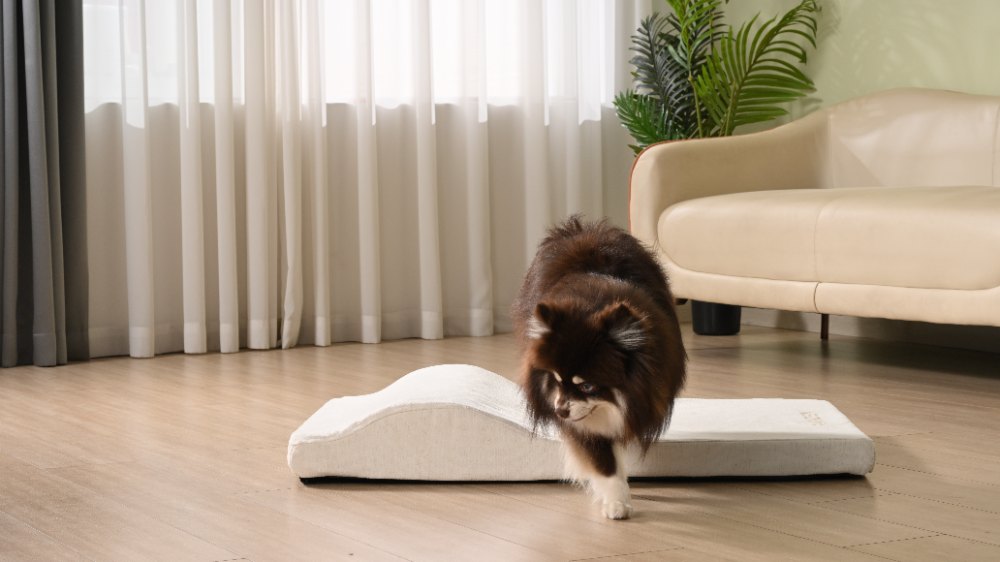
Picking a dog bed for a crate is not the same as picking one for the living room floor. The size tolerance is tighter, the ventilation is weaker, and during crate training, accidents are frequent enough to treat as routine. A bed that works fine in an open room can fail on all three counts inside a crate.
Quick Reference: What a Crate Bed Needs
| Property | Why It Matters in a Crate |
| Precision fit | Crate interiors typically run 2–4 inches smaller than the labeled size; measure before buying |
| Fast-drying core | Limited ventilation and training accidents demand same-day recovery |
| Waterproof liner | Accidents during crate training are expected; a liner keeps the core dry |
| Non-slip base | Smooth crate floors cause beds to shift and leave areas uncovered |
Why a Regular Dog Bed Doesn't Work Well in a Crate?
Size Tolerance Is Almost Zero
A dog bed on the living room floor can be an inch too wide without anyone noticing. Inside a crate, that same inch causes the edge to fold against the wire wall, creating a raised ridge the dog cannot lie flat against.
A bed that is too small leaves part of the wire floor uncovered when the dog stretches out.
Most wire crate manufacturers label by external dimension. The actual interior of a "36-inch crate" typically runs 2–4 inches shorter depending on brand and wire gauge. A bed purchased by crate label rather than measured interior dimension will fit by coincidence, not design.
Ventilation Is Restricted
Wire walls allow some airflow, but the interior of a crate remains considerably more enclosed than open floor conditions.
For foam-based cores, two problems follow: body heat accumulates under the dog more readily, and a washed core dries more slowly inside a crate than on an open surface.
That heat buildup connects directly to how dogs cool themselves.
Dr. Christina Gentry, Clinical Assistant Professor at Texas A&M College of Veterinary Medicine, notes that "with their limited ability to truly sweat ... most thermoregulation is done via panting, ear flaps and coat length, color, or type."
A foam surface that traps heat forces that already limited system to work harder inside an enclosed crate.
Accidents Are a Normal Part of Crate Training
The American Kennel Club notes that puppies can't control their bladder until they're about 16 weeks old, and after that can typically only hold their bladder for the same number of hours as the number of months of their age plus one.
Full housetraining typically takes 4–6 months. Crate accidents during this period are predictable, not failures.
A foam bed that needs 24–48 hours or longer to fully dry after a soaking is not practical at this stage. Moisture can linger inside the foam even after the surface feels dry. The dog either returns to a damp surface or waits with no cushioning while the bed dries elsewhere.
No Fallback for Comfort
In an open room, a dog that finds the bed too warm can move to the floor. Inside a crate, that option does not exist. The dog stays on the bed or presses against the wire floor.
Thermal comfort and cleanliness matter more in a crate than anywhere else in the home precisely because there is no self-correcting option.
How to Measure for a Crate Bed (Before You Buy Anything)
Most product listings say things like "fits 36-inch crates." That label is not reliable as a primary reference. The only number that matters is the crate's actual interior measurement, which means measuring the interior directly.
Three Numbers to Record
- Interior length: Open the door and measure from the inner surface of one end panel to the inner surface of the opposite end. This number is typically 2–4 inches shorter than the crate's labeled size.
- Interior width: Side wall to side wall, inner surface to inner surface. On folding metal crates, check for crossbars or locking hardware that protrudes inward and reduces the usable flat area.
- Tray clearance: Many wire crates have a plastic or metal tray raised slightly off the base. If the bed's thickness plus the tray height exceeds the door's lower frame height, the door will compress the bed or fail to close cleanly.
The Sizing Rule
A crate bed's finished dimensions should sit slightly smaller than the interior measurement, typically around 0.5 inches per side.
This lets the bed lie flat without folding at the edges and accommodates minor fill movement without the bed jamming against the walls.
Finished dimensions vary between brands even for beds marketed for the same crate size. Always compare the product's stated finished dimensions against your measured interior, not against a crate size chart.
The rule: Bed finished size smaller than crate interior = correct. Equal or larger = problems.
What Material Properties Actually Matter Inside a Crate?

Fast Drying
Drying speed is the most operationally critical property for any dog crate pad. A foam core, including memory foam, absorbs liquid deep into its structure.
Even after 24–48 hours of drying in open-air conditions, moisture can remain inside. In a crate with restricted airflow, that window stretches further.
An open-fiber core works differently.
Water flows through the material rather than soaking into it, so the core reaches a usable state more quickly even if full drying takes a similar amount of time.
For a dog returning to the crate after an accident, that structural difference matters.
A Waterproof Liner
During crate training, liquid accidents are predictable, not occasional.
A waterproof liner stops liquid at the cover layer, keeping the core dry and reducing cleanup to a cover-only wash.
The liner needs to wrap the full surface of the core, not the top panel only. Liquid inside a crate can reach the core from the sides as well as the top.
A Non-Slip Base
Crate floors (metal tray or plastic base) are smooth. A crate pad without a non-slip backing drifts toward one end as the dog shifts, leaving part of the floor without any cushioning.
This is not a comfort preference. It directly determines how much of the crate floor stays covered during use.
Even Support Over Thickness
Thick beds reduce headroom and compress standing space inside the crate. A surface that provides uniform support without sinking or clumping protects joints more effectively than a thicker bed that develops uneven pressure points.
For a dog crate mattress, consistency of support matters more than height.
How to Vet a Crate Bed Before You Buy

Run through this checklist before purchasing:
- Finished dimensions are listed. Actual length and width stated on the product page, not a crate size compatibility label, so you can compare directly to your measured interior.
- Core cleaning instructions are specified. "Machine-washable cover" does not mean the bed is washable. If the product page does not address how the core cleans, the core likely cannot be cleaned effectively.
- Drying time is determinable. For active crate training, a core that dries in hours rather than days makes same-day reuse realistic.
- Waterproof liner covers all surfaces. A top-only liner leaves the sides exposed to liquid that travels from the crate walls.
- Non-slip base is confirmed. If the product page does not mention it, ask before purchasing.
Why Choose the FURIZEN Zenest Ridge™?
The Zenest Ridge™ Washable Orthopedic Dog Bed is precision-cut to slide into standard 36" crates with no trimming and no gaps. Its ZephyrTech™ air-fiber core uses an open-fiber woven structure that rinses clean under running water. Because water flows through the material rather than soaking into it, the open-fiber structure lets water drain out rather than soak in — it dries in hours, not days, unlike memory foam that stays damp for days.
The outer cover removes for machine washing on a gentle cold cycle. The core rinses under a showerhead and stands upright to dry. Both are ready to return to the crate the same day an accident occurs.
The Zenest Ridge™ carries a 10-Year Bounce-Back Warranty on the ZephyrTech™ air-fiber core and a 100-Night Sleep Trial.
The Zenest Ridge™ carries a 10-Year Bounce-Back Warranty on the ZephyrTech™ air-fiber core and a 100-Night Sleep Trial.
Get the Bed Right Before Training Starts
Crate training asks a lot of a dog. A bed that fits properly, stays clean, and dries fast removes one source of friction from a period that already has enough of it. Your dog does not notice the checklist. They notice whether the surface feels right, smells clean, and holds up night after night. Get that part right from the start.
FAQs
Q1: Should I put a bed in my dog's crate during crate training?
Yes, with a caveat. Use a thin, fast-drying pad during the accident-prone early weeks. Foam absorbs liquid deep into its structure and can take 24–48 hours or longer to fully dry, which is impractical when accidents happen regularly. Switch to a more supportive bed once your dog has been consistently accident-free for several weeks.
Q2: My dog chews or digs at the crate pad. What should I do?
Chewing typically signals anxiety or boredom, not a bedding problem. At the material level, choose a durable outer fabric such as Oxford cloth and avoid loose polyfill. If chewing continues, a flat, fill-free mat is safer than replacing filled beds repeatedly.
Q3: Can I use a regular dog bed in a crate if it fits?
Yes, if it meets three conditions: it lies completely flat without folding at the edges, the material cleans quickly enough for your situation, and the thickness does not reduce headroom. Meet all three and a standard bed works fine in a crate.
Q4: What is the difference between a crate pad and a crate mat?
The terms are interchangeable in most listings. If a distinction exists, crate pad typically implies a thicker filled product while crate mat implies a thinner flat layer. Focus on actual thickness, fill material, and cleaning method. The product name does not change performance.
Sources
- Gibeault, S. (2025). Why Does My Puppy Pee in the House? American Kennel Club. https://www.akc.org/expert-advice/puppy-information/why-does-my-puppy-keep-peeing-in-the-house/
- CDC. (2024). Mold: Facts About Mold and Dampness. https://www.cdc.gov/mold-health/about/index.html
- IVHS & SPCA. (n.d.). Potty Training. https://ivhsspca.org/potty-training/
Share:
Do Dogs Need a Bed or Is the Floor Fine? (Especially for Seniors & Big Dogs)
How to Wash a Dog Bed Without Ruining It