

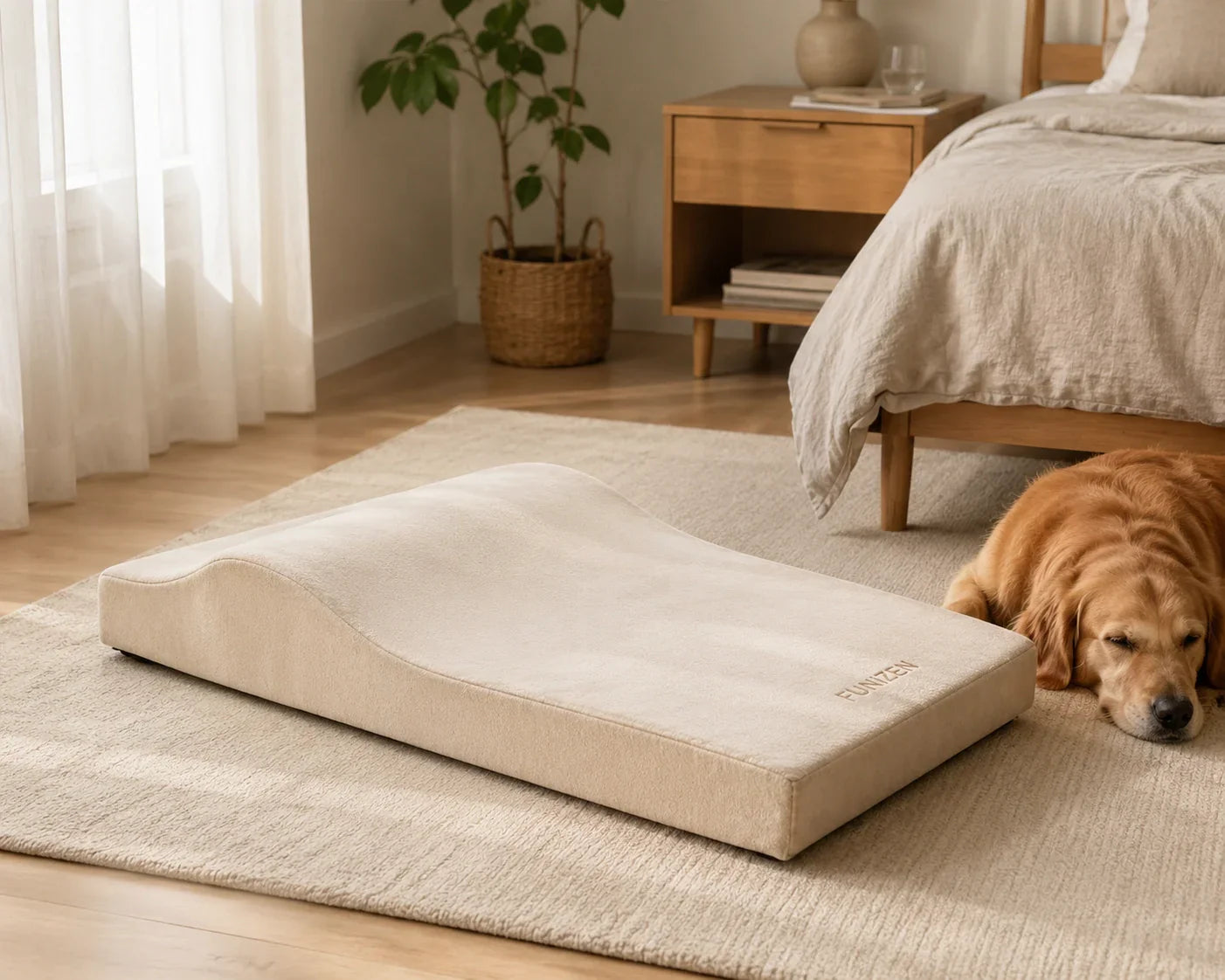
Dog beds take a lot of daily wear: fur, drool, tracked-in dirt, the occasional accident. Most people know how to wash a dog bed in theory: pull the cover off, run it through the machine, done. But if the bed keeps smelling after regular washes, the cover was never the source. The smell lives deeper, and clearing it out requires a different approach than most people expect.
Quick Reference: Do's and Don'ts
| What to Clean | Do | Don't |
|---|---|---|
| Outer cover | Cold wash (60–104°F), gentle cycle, low-heat or air dry | Bleach detergents, high-heat drying, washing with zipper open |
| Foam core | Wipe surface with damp cloth and mild soap, air dry flat | Machine wash, soak, reassemble before fully dry |
| Air-fiber core | Rinse under running water, stand upright to air dry | Machine wash, tumble dry |
Why Washing Only the Cover Falls Short
The Cover and the Core Don't Collect the Same Things
The outer cover handles direct contact: fur, dust, surface grime. A machine wash clears that layer effectively.
The problem is that dogs drool on their beds, have accidents, and liquid from a damp cover replaced too early can seep inward during the cycle itself.
Liquids do not stop at the fabric layer. They pass through and settle into whatever material sits underneath.
Once organic material reaches the core (urine proteins, saliva enzymes, residual moisture), it stays. It breaks down slowly, and as it does, it produces the persistent odor that does not wash out.
The American Kennel Club notes that over time, washing may not fully remove ingrained dirt, stains, and odors from a dog bed.
Foam Cores Are Harder to Clean Than They Look
Standard memory foam and high-density foam cannot go in the washing machine. Agitation damages the internal cell structure, and the fill absorbs water deeply, requiring 24 to 48 hours to dry fully.
Liquid that has already migrated further in is out of reach entirely.
The standard care instruction for foam is to wipe the surface with a damp cloth and air dry.
That method cleans roughly the top one to two inches. Anything deeper might remain there.
Partial moisture during cleaning, particularly if the foam is reassembled too soon, creates a warm, humid interior environment that accelerates bacterial growth (Qiu et al., 2022).
Core Washability Sets the Hygiene Ceiling
A bed with a washable cover and an unwashable core has a fixed hygiene ceiling: the cover refreshes, but the core accumulates contamination with no way to reset it. That ceiling locks in the first time liquid reaches the core. Every subsequent wash cleans the outside while leaving the inside unchanged.
Genuine cleaning requires the core itself to be washable, and to dry fast enough afterward that residual moisture does not create a secondary problem.
A Quick Self-Check
Press your face close to the center of the dog bed, directly above the core, and smell without the cover filtering the air. A noticeable odor from that area means the source is inside. Washing the cover will not change it.
How to Wash the Dog Bed Cover, and What Ruins It
Washing the cover correctly still matters. Even if the core holds the deeper contamination, a clean cover reduces surface-level buildup and extends time between core washes.

Step 1: Pre-Treat Stains
Check the cover for visible stains (mud, feces, blood) and pre-rinse those spots with cold water and a small amount of mild, fragrance-free soap. Cold water is critical at this stage. Heat will permanently set protein-based stains by binding them into fabric fibers, making removal harder (Nebraska Humane Society). This applies to anything from urine residue to saliva and blood.
Step 2: Machine Settings
- Temperature: Cold to warm, 60–104°F. Higher temperatures cause most cover materials to shrink or distort, especially fabrics containing elastic fibers.
- Spin speed: Medium-low. High-speed spin stresses stitching and zipper hardware, which shortens the cover's lifespan.
- Detergent: Unscented, no optical brighteners. Strong fragrance is overwhelming to dogs and may cause them to avoid the freshly washed bed. Optical brighteners can irritate sensitive skin in certain breeds.
Step 3: Drying
Low-heat tumble dry or air dry flat. High-heat drying accelerates fabric aging and can separate bonded layers in any waterproof liner. If air drying, confirm the cover is completely dry and then return it to the core. A damp cover transfers residual moisture directly into the fill.
Three Operations That Reliably Damage Covers
| What to Avoid | Why It Causes Damage |
|---|---|
| Bleach-based detergents | Breaks down fiber structure and degrades protective waterproof coatings |
| High-heat drying | Cover shrinks and no longer fits the core; seam stress increases near zippers |
| Washing with the zipper open | Metal zipper teeth scratch inner fabric and neighboring laundry throughout the cycle |
How to Clean the Dog Bed Core?
Foam Cores
Foam is not machine washable. Water pressure and agitation damage the internal air-pocket structure. The drying window runs 24 to 48 hours at a minimum, and that extended wet period creates additional risk of moisture-related bacterial growth.
The practical cleaning method for foam is surface cleaning:
- Mix cold water with a small amount of mild soap, or prepare a 1:1 white vinegar and water solution
- Wipe the foam surface gently with a clean cloth or sponge
- Follow with a clean damp cloth to remove soap residue
- Lay flat in a well-ventilated area to dry (standing wet foam upright causes it to deform under its own weight)
- Confirm the foam is fully dry, then replace the cover, typically 24 to 48 hours
But this method cleans the surface layer of foam only.
Air-Fiber Cores

Open-fiber cores can be rinsed with running water through the entire structure, not the surface only. This is what "dog bed washable inside and out" actually requires in practice:
- Remove the core from the cover
- Rinse under a showerhead or garden hose at moderate pressure, working top to bottom
- Work in a small amount of mild detergent by hand if needed, then rinse thoroughly
- Stand upright or hang in a ventilated area to dry
Unlike memory foam that stays damp for days, the open-fiber structure lets water drain out rather than soak in — it dries in hours, not days. The open-fiber structure has no sealed interior chambers, so liquid cannot become trapped. Water flows through the same channels where organic material accumulates.
How Often Should You Wash a Dog Bed?
| What to Clean | Base Frequency | Increase When... |
|---|---|---|
| Outer cover | Every 1-2 weeks | After accidents / noticeable odor / allergy-prone dogs: weekly |
| Foam core surface wipe | Every 1–2 months | After liquid penetration / odor coming from core area |
| Air-fiber core rinse | Every 1–2 months | After accidents: same day / high-humidity months: more frequently |
A practical habit worth building: wash the dog bed cover every time you wash your own household bedding. It removes the need to track a separate schedule and keeps frequency consistent.
Four Situations That Call for Immediate Cleaning
1. Accidents (Urine, Vomit, or Diarrhea)
Do not wait for the next scheduled wash. Liquid penetrates the core fast, and earlier rinsing means less organic buildup. Press a dry towel into the surface to absorb liquid: press and hold, do not rub. Rubbing spreads liquid sideways and pushes it deeper into the layers. Then clean the cover and core using the appropriate method above.
2. Odor Detected Near the Core
Use the self-check described above. Odor coming from the core area signals that organic buildup is already present. Address it immediately rather than waiting for routine maintenance.
3. Your Dog Stops Using the Bed
Dogs detect odors at concentrations roughly 10,000 to 100,000 times lower than humans (Frontiers in Veterinary Science). If your dog starts choosing the floor over the bed, smell is the first factor to investigate, often weeks prior to anyone in the household noticing anything. Rule out support failure first, then address the core.
4. High Humidity or Seasonal Transitions
High humidity accelerates mold and bacterial activity in porous materials.
As CEE notes, "avoid humidity levels above 60 percent RH in the summer to prevent mold and bacterial growth" (CEE, 2025)
During summer or extended rainy stretches, increase cover washing frequency and clean the core more often accordingly.
Start With a Bed That Actually Rinses Clean
Most dog beds give you a washable cover and a core that permanently accumulates everything that soaks through. The FURIZEN Zenest Ridge™ washable dog bed takes a different approach. Its ZephyrTech™ air-fiber core, an open-fiber woven structure, rinses clean under running water through the entire core, not the cover alone, and dries within 24 hours in a ventilated area. There are no sealed interior chambers for liquid to hide in.
Washing dog bed smell away stops being a losing battle when the core can actually be flushed out. Less fuss. More bond.
The Zenest Ridge™ comes with a 100-Night Sleep Trial and a 10-Year Bounce-Back Warranty on the ZephyrTech™ air-fiber core.
FAQs
Q1: Can I put a whole dog bed in the washing machine?
It depends on the fill. Small beds stuffed with cotton or polyfill can usually go in whole, provided the machine has enough capacity — fill absorbs water and becomes considerably heavier when wet. Foam-core beds should not be machine washed. Agitation damages the foam's internal structure and the spin cycle cannot remove deep moisture, leaving the core wet for days. Air-fiber cores can be rinsed with running water but do not require machine washing; hand rinsing is more thorough and gentler on the fiber structure.
Q2: What is the best way to get urine smell out of a dog bed?
- Press a dry towel onto the wet area and hold. Do not rub.
- Rinse with cold water. Hot water bonds urine proteins into fabric fibers.
- Apply a 1:1 white vinegar and water solution to the area and let it sit for 10 minutes. The acidity neutralizes ammonia compounds produced as urine breaks down.
- Rinse thoroughly and dry completely.
If odor returns after drying, urine has reached the core. Surface treatment will not eliminate it at that point, and core washability becomes the deciding factor.
Q3: Can I use a dryer sheet or fabric softener when washing a dog bed?
No. Fabric softener contains fragrance compounds that are overwhelming at a dog's level of scent sensitivity. Most dogs avoid the bed for days after washing until the smell fades. Dryer sheets contain cationic surfactants and synthetic fragrance that can irritate skin in puppies and dogs with sensitivities. A safe alternative: add a small amount of baking soda to the final rinse cycle. It neutralizes odor without adding scent and is safe for both dogs and people.
Q4: My dog's bed stuffing clumps after washing. How do I fix it?
- While the fill is still damp, redistribute it manually: squeeze and pull clumps apart through the outer fabric.
- Tumble dry on low heat.
- Stop every 15 to 20 minutes to break up new clumps and redistribute the fill by hand.
- Repeat until fully dry.
If the fill has already dried in a clumped shape, full restoration is difficult. This is also why polyfill and cotton beds lose their support faster than structured-fill alternatives after repeated washes.
Sources
- Johnstone, G. (2026). How to Clean Your Dog's Bed and Why It's Important. American Kennel Club. https://www.akc.org/expert-advice/home-living/how-to-clean-a-dog-bed/
- Qiu, Y., et al. (2022). The Effects of Ventilation, Humidity, and Temperature on Bacterial Growth and Bacterial Genera Distribution. International Journal of Environmental Research and Public Health. https://pmc.ncbi.nlm.nih.gov/articles/PMC9691097/
- Nebraska Humane Society. (n.d.). Pet Odors and Stains. Nebraska Humane Society. https://nehumanesociety.org/services/pet-tips-behavior-help-and-resources/pet-odors-and-stains/
- Higgins, C. (2025). Managing Humidity Levels. Center for Energy and Environment. https://www.mncee.org/managing-humidity-levels
- Jenkins, E. K., et al. (2018). When the Nose Doesn't Know: Canine Olfactory Function Associated With Health, Management, and Potential Links to Microbiota. Frontiers in Veterinary Science. https://pmc.ncbi.nlm.nih.gov/articles/PMC5884888/
Share:
The Best Dog Bed for a Crate: Sizing, Fit, and Washability
What a Waterproof Dog Bed Cover Actually Protects Against