

You bought a "waterproof" dog bed. Your dog had an accident. You found the foam soaked through anyway. The "waterproof" label on a dog bed covers several very different structures, and most of them won't hold up when it counts.
Quick Answer: What Does a Waterproof Dog Bed Cover Protect Against?
| Scenario | Standard DWR Cover | True Waterproof Liner | Washable Open-Fiber Core |
|---|---|---|---|
| Urine (caught immediately) | May bead off | Blocked | Rinse clean |
| Urine (soaked in for minutes) | Penetrates under body weight | Blocked | Rinse clean |
| Edge/side seam leakage | Not covered | Depends on coverage | Rinse clean |
| Odor from inside the core | No protection | No protection | Water flows through |
| Core hygiene after liner wears out | Exposed foam | Exposed foam | Still washable |
Does "Waterproof" Do What You Think It Does?
Not always. On dog beds, "waterproof" covers at least two very different structures, and most product listings don't tell you which one you're getting.
Water-resistant coating (DWR): A surface treatment that causes liquid to bead up and roll off, the same technology used on rain jackets. The catch: body weight breaks the surface tension. When your dog lies down, pressure pushes liquid through the fabric within minutes.
Waterproof liner membrane: A separate physical barrier, typically TPU or PVC film, sewn into the cover's inner layer. This blocks liquid regardless of pressure. It does not degrade from use, only from heat or repeated abrasion over time.
| Feature | Water-Resistant Coating | Waterproof Liner Membrane |
|---|---|---|
| How it works | Surface repellency | Physical barrier |
| Fails under body weight? | Yes | No |
| Degrades with washing? | Yes, gradually | No (heat is the risk) |
| Labeled "waterproof"? | Often | Yes |
If a product page says "waterproof cover" without specifying a liner, membrane, or TPU layer, it likely has a surface coating only.
What a Waterproof Liner Actually Protects Against

A true waterproof liner does its job well in three situations. Knowing where it stops is equally useful.
What it blocks:
Urine or vomit that lands on the surface and starts to seep down. If you catch the accident quickly, the liner keeps the core completely dry. It also handles incidental moisture from outdoor use or the washing cycle itself.
Where it still fails:
- Edge penetration. If the liner only covers the top face of the core, liquid that spreads to the edges can seep around the sides. Large dogs and high-volume accidents make this more likely.
- Prolonged saturation. Liners are designed to stop fast penetration, not to hold standing liquid for hours. Seams and stitch points are the weak spots under sustained pressure.
- Aging. High-heat drying is the primary cause of liner degradation. The adhesive layer separates first, showing up as bubbling or delamination on the inner surface. Once that starts, waterproof performance drops unevenly across the cover.
How Do You Know If Your Waterproof Layer Has Stopped Working?
Three signs to check for, in order of severity.
1. Bubbling or peeling on the inner surface.
Peel back the outer cover and look at the liner side. Bubbling is the first sign that the adhesive layer is separating. At this stage, performance has already dropped in those areas.
2. Liquid on the core-facing side of the liner.
After an accident, check the side of the liner that touches the core. If it feels damp, that is the most direct evidence of failure.
3. Persistent smell after washing.
If the cover has been washed and still smells, liquid has likely made it past the liner at some point and the core has been affected. The cover itself is not the source.
If you see the first sign, monitor closely. If you see the second or third, the cover needs replacing. Washing will not restore liner integrity.
Why Does the Bed Still Smell After Washing?
A waterproof liner redirects liquid. It does not make it disappear. After an accident, liquid soaks into the outer cover's fabric layer and stops at the liner. If you wash the cover promptly, the fabric layer comes clean. That part works.
The problem surfaces in two situations. First, if the liner has worn or liquid reached the core through a seam, the foam absorbs it. Foam absorbs moisture and organic matter deep into its structure, where it cannot be washed out.
Dr. Marty Becker, DVM, notes that a pet's unwashed bed "can be the source of parasites, bacteria or viruses," and that bacteria accumulate the same way they do in human bedding: through oils, moisture, and organic residue. (Vetstreet, 2017)
Even with a functioning liner, the cover's own fabric layer holds bacteria. The American Kennel Club, citing the Canadian Medical Association Journal and CDC, recommends washing dog bedding weekly to reduce the risk of zoonotic bacteria and parasites. (AKC, 2024)
Washing the cover handles the fabric layer. It cannot reach whatever has accumulated inside a foam core.
Is Washing the Cover Enough?
No. For a foam bed, washing the cover addresses the surface. The core is a separate problem.
Foam absorbs liquid deep into its structure. Water cannot flow through it to rinse residue out. Bacteria, urine compounds, and allergens that reach the foam stay there. Over time, that accumulation builds regardless of how often the cover is washed.
A common pattern among dog owners: hundreds of dollars spent on beds, urine still reaching the foam, and no amount of washing solving the smell. The waterproof liner buys time, but it does not solve the hygiene limit of the core.
The EPA recommends deep-cleaning dog beds every two to three weeks with soap and water to control flea infestations and bacterial buildup.
For a foam bed, however, "deep cleaning" has no practical effect. Foam absorbs liquid deep into its structure, where running water cannot reach.
A waterproof cover, paired with a core that cannot be cleaned, is a delay. The core's hygiene will degrade. The only question is how quickly.
What Actually Keeps a Dog Bed Clean Long-Term
Two factors determine long-term cleanliness: a cover that washes reliably, and a core that can be cleaned when the cover is not enough.
Cover checklist:
- Does it have a true waterproof liner membrane, or only a surface coating?
- Does the liner wrap all sides of the core, or only the top face?
- What are the washing temperature limits? High heat shortens liner life by a notable margin.
Core checklist:
- Can water flow through the core material, or does it absorb and trap?
- Can the core be rinsed under running water and dried completely?
- If the waterproof layer ever fails, does the core remain salvageable?
For homes with puppies in crate training or senior dogs with incontinence, the core question determines long-term cost. A bed requiring core replacement after the first major accident is a recurring expense. A bed with a rinseable core is a different category.
Meet the FURIZEN Zenest Ridge™
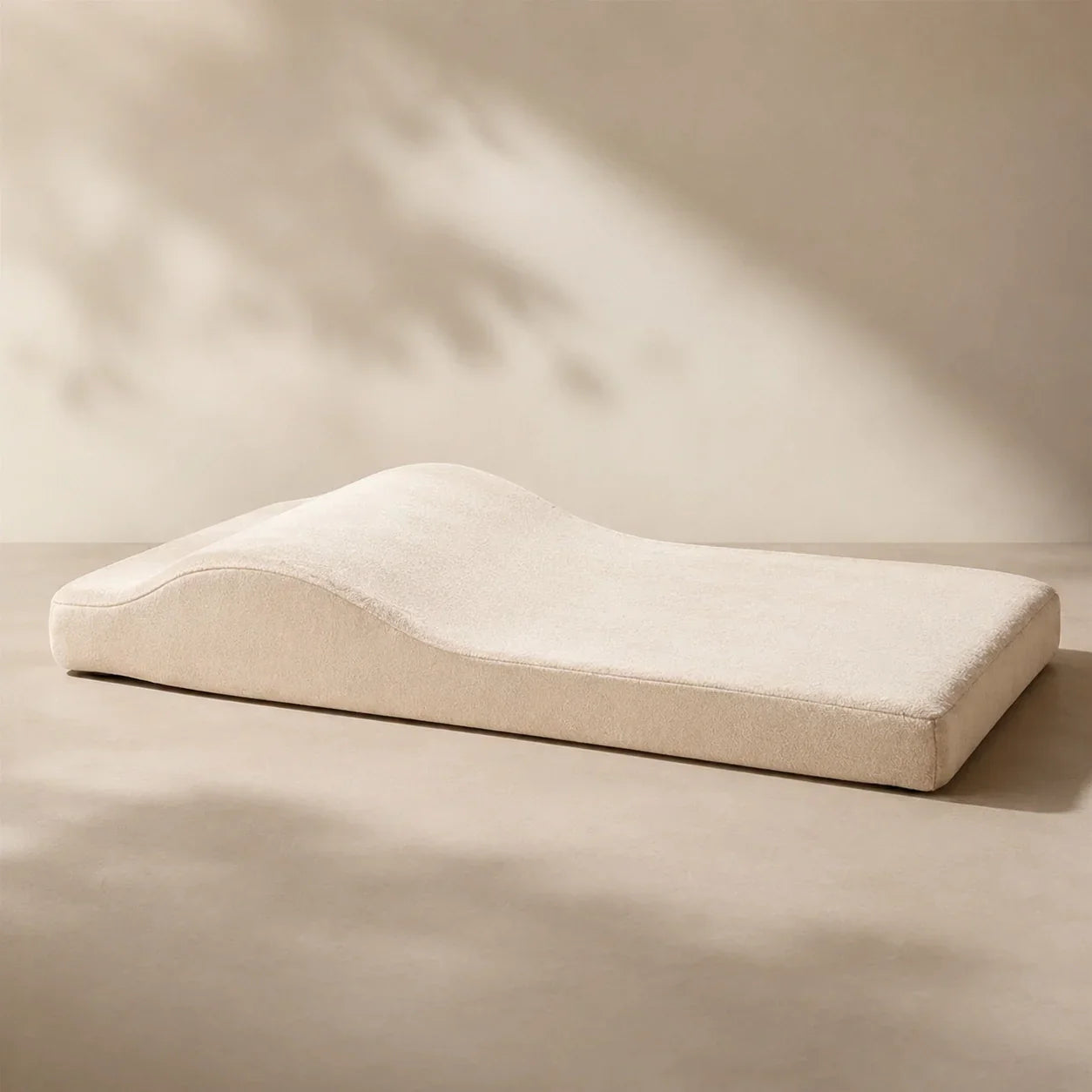
The Zenest Ridge™ Washable Orthopedic Dog Bed was built around a different starting point: not how to protect the core from water, but how to make the core itself washable.

The ZephyrTech™ air-fiber core uses an open-fiber woven structure. Water flows through the entire core under a running tap, carrying residue out with it. Open-fiber structure dries fast and rinses clean — no fabric to hold onto dampness the way foam does.
Stand the core upright in a ventilated area. Unlike memory foam that stays damp for days, the open-fiber structure lets water drain out rather than soak in — it dries in hours, not days.
The removable outer cover handles daily maintenance. Machine wash on a gentle cycle with cold water, air dry or tumble dry low. Wash it every 1-2 weeks, or sooner after accidents.
Care at a glance:
| Component | Method | Frequency |
|---|---|---|
| Outer cover | Machine wash, gentle cycle, cold | Every 1–2 weeks |
| ZephyrTech™ core | Rinse under running water, air dry | As needed: accidents, seasonal, or every 4–6 weeks |
The ZephyrTech™ core is backed by a 10-Year Bounce-Back Warranty. Less fuss. More bond.
Frequently Asked Questions
Q1: Are waterproof dog beds actually good for dogs?
A waterproof liner is genuinely useful during the period it is working correctly. It keeps the core dry after accidents and makes the cover easier to clean. The limitation is that it does not address what happens to the core if the liner degrades or liquid reaches the core through seams or edges. A waterproof liner paired with a core that can be cleaned independently is more effective than a liner alone.
Q2: How do I know if my dog bed's waterproof layer has worn out?
Check the inner surface of the cover (the side facing the core). Visible bubbling or delamination indicates the adhesive layer has started to separate. After an accident, check the liner's core-facing side for dampness. If the cover smells after washing, liquid has likely reached the core at some point. The first sign is a warning; the second and third signal the cover needs replacing.
Q3: How do I pee-proof a dog bed?
The most reliable approach combines two things: a cover with a true waterproof liner membrane (not a surface DWR coating), and a core material that can be rinsed clean if liquid ever gets through. A waterproof liner alone delays the problem. A washable core solves it. For dogs in crate training or with incontinence, a bed that fits the crate precisely also prevents liquid from pooling in gaps along the edges.
Q4: How often should I wash my dog's bed?
Recommendations vary by purpose. The AKC and CDC recommend weekly washing to reduce bacterial and zoonotic risk. The EPA's guidance targets flea control specifically, recommending deep-cleaning every two to three weeks. For routine maintenance, every one to two weeks is a practical baseline — adjust based on your dog's habits and any accidents.
Need a Bed That Rinses Clean?
The Zenest Ridge™ ships free to the continental US. Your dog gets 100 nights to decide, backed by our 100-Night Sleep Trial. And the ZephyrTech™ core is covered by a 10-Year Bounce-Back Warranty.
Sources
- Becker, M. (2017). Am I a Bad Pet Owner If I Never Wash My Pet's Bed? Vetstreet. https://www.vetstreet.com/dr-marty-becker/am-i-a-bad-pet-owner-if-i-never-wash-his-bed
- American Kennel Club. (2024). How to Clean Your Dog's Bed and Why It's Important. AKC. https://www.akc.org/expert-advice/home-living/how-to-clean-a-dog-bed/
- U.S. Environmental Protection Agency. (n.d.). Controlling Fleas and Ticks Around Your Home. EPA. https://www.epa.gov/pets/controlling-fleas-and-ticks-around-your-home
Share:
How to Wash a Dog Bed Without Ruining It
The Best Dog Beds for Senior Dogs: Protect Your Dog As They Age