

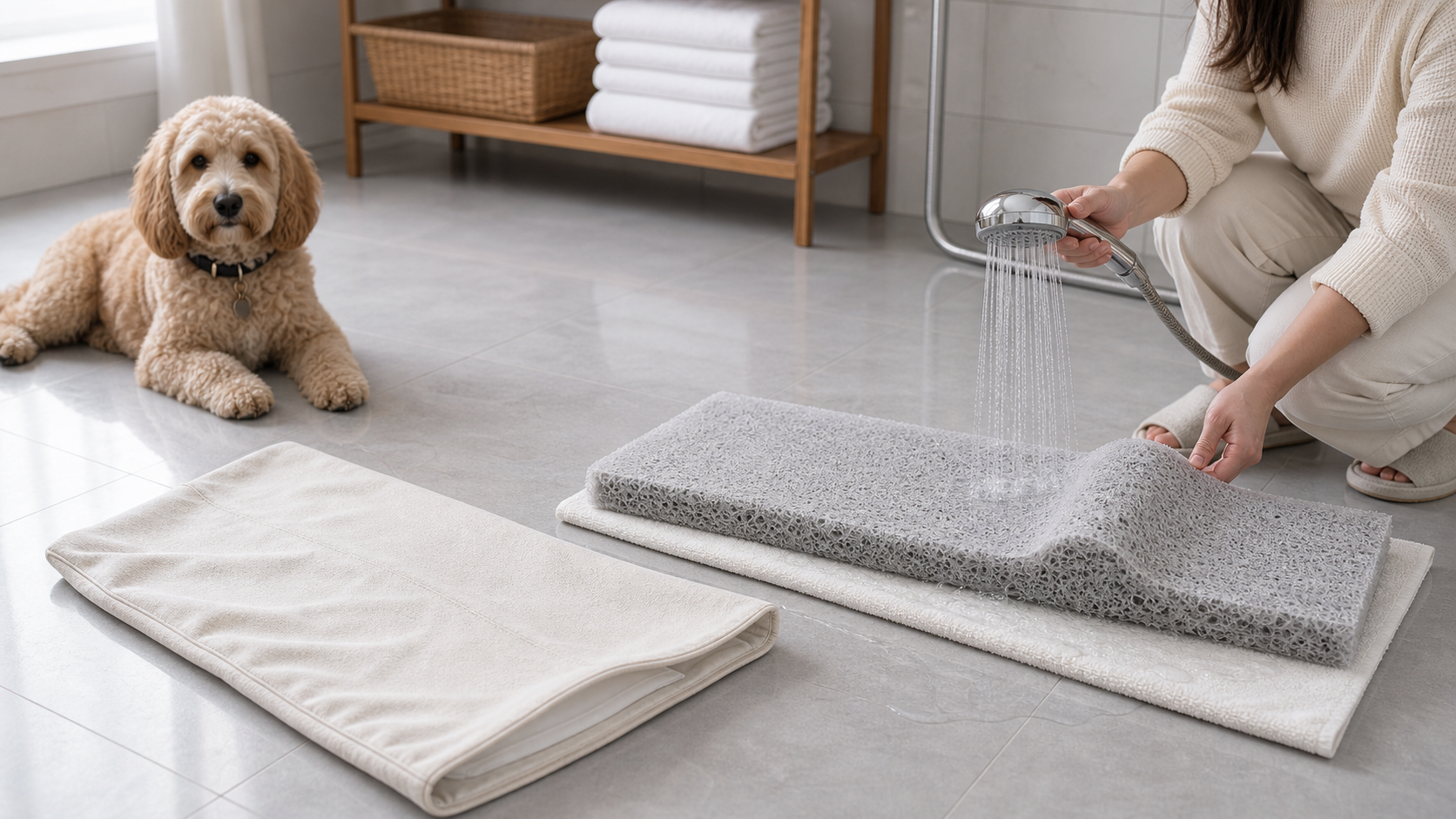
You wash the cover, but a few days later, the annoying smell just returns. Why? Because it's never easy to truly clean your dog bed, inside and out.
Most dog beds are designed in a way that makes it nearly impossible to fully remove odor. If you want to find an odor-resistant dog bed that actually stays fresh, it helps to understand why it gets smelly in the first place.
Quick Reference: Dog Bed Odor
| Smell source | Why it comes back after washing | What actually fixes it |
| Natural skin oils soaking into the core | Cover washing doesn't reach the core | A core that can be rinsed clean |
| Bacteria growing in warm, damp foam | Foam stays wet for a long time; bacteria thrive in that window | An open-fiber core that dries quickly |
| Urine soaking deep into the foam | Uric acid crystals lock into foam and release smell whenever the bed warms up | A waterproof liner that blocks liquid from reaching the core |
Where Is the Smell Is Coming From?
Most owners figure the odor is just part of having a dog. That is partly true. It is why the smell keeps living inside the bed no matter how often you clean it that actually matters.
- Natural skin oils. Dogs have naturally oily skin. Every time they lie down, that oil transfers directly into the bed surface. Foam absorbs it and does not let go.
- Moisture from paws and coat. After a walk or a rainy day, a dog brings a lot of moisture with them. It soaks into the core fast, and foam takes a long time to dry out.
- Bacterial activity. A dog's body temperature sits between 100.5°F and 102.5°F (College of Veterinary Medicine), warmer than ours. That warmth plus trapped moisture creates ideal conditions for bacteria. Those are the actual chemicals behind the persistent smell.
- Shed hair and dander. Dead skin cells and loose fur work their way into foam over time. They are difficult to fully remove and give bacteria more material to feed on.
- Urine accidents. Urine soaks through foam within minutes. Bacteria convert it to ammonia quickly, producing the sharp smell you notice right away. The longer-term problem is uric acid: as urine dries, it forms crystals that lock into the foam structure and do not wash out with water. Every time the bed warms up or gets slightly damp, those crystals release the smell all over again.
All of these end up inside the core, not just on the surface of the cover. As Dr. Zenithson Ng, a board-certified veterinarian and clinical assistant professor at the University of Tennessee College of Veterinary Medicine, notes, not cleaning pet items "can lead to localized skin infections if your skin is in constant contact with the dirty item" (PetMD). A bed whose core cannot be cleaned stays dirty in ways that affect more than just the smell.
Why the Smell Keeps Coming Back After Washing?
You Are Washing the Outside, Not the Inside
Most dog beds are designed so that only the cover comes off to be washed. That cover can come out perfectly clean.
But the smell is not living in the cover. It is in the core, which may never gets cleaned.
Putting a fresh cover back on that core is a bit like wiping down the outside of a container that has something fermenting inside. It looks cleaner, but within a few days the smell comes right back through.
Washing the Cover Can Actually Make It Worse
When the cover goes through the wash, some moisture gets into the core in the process. Foam holds that moisture and takes a long time to dry out fully.
While it stays wet, bacteria have more time to grow.
This is why some owners notice their dog's bed smells worse a day or two after washing it: the foam did not dry out, it just got wetter.
Uric Acid Crystals Survive the Wash
Uric acid crystals do not dissolve in water. The washing machine cannot break them down, and neither can regular laundry detergent. Even after ten washes, the crystals are still in the foam.
Every time the bed gets warm or slightly damp again, whether from your dog lying on it or humidity in the room, those crystals release the smell. A bed with any history of urine accidents will keep doing this indefinitely if the core has never been cleaned.

What "Odor Resistant" Means, and What It Doesn't
Walk through any pet bedding section and you will see "odor resistant," "antibacterial," and "smell proof" on a lot of labels. These terms are not regulated in the pet product industry, so they can mean almost anything. Here is what the three most common approaches actually do.
| What "Odor Resistant" Means | What It Doesn't |
| Antibacterial: Treats the surface only. | Does not reach the core or survive repeated washes. |
| Charcoal: Traps odors temporarily. | Does not last forever (cannot be washed or reset). |
| Enzymes: Manages daily surface smells. | Does not penetrate the foam to fix the root cause. |
| Bottom Line: Temporary, surface-level fixes. | Does not stop the core from absorbing liquids and staying damp. |
Antibacterial Surface Treatments
Beds marketed as antibacterial usually have a chemical treatment applied to the surface of the fabric or foam. That treatment does reduce bacteria on the surface.
The catch is that it washes out a little every time the bed gets cleaned. Most of the bacteria driving the odor are not on the surface anyway. They are inside the core, where the treatment never reaches.
Activated Charcoal Filling
Activated charcoal traps odor molecules in its tiny pores. It works until those pores fill up.
Once the charcoal is saturated, it stops working. Washing does not reset it. For a bed in daily use, that odor-absorbing capacity has a built-in expiration date with no way to extend it.
Enzyme Sprays
Enzyme-based sprays break down organic matter on the surfaces they contact, and they do work for surface odor between washes. The limitation is the same one that runs through all of these solutions: the odor source is inside the foam core, and a spray cannot reach it.
These are useful for managing day-to-day smell, but they are not solving the underlying problem.
All three approaches add something onto a bed that still absorbs liquid, stays damp, and cannot be thoroughly cleaned inside. None of them change what the core is made of.
What a Bed That Actually Stays Clean Looks Like
Once you understand where the odor is actually coming from, the questions to ask about any dog bed become pretty specific.
Can the Core Actually Be Washed?
A removable, washable cover is standard at this point. The more important question is: what happens when liquid reaches the core?
Check the product page carefully. If it only talks about washing the cover and says nothing about the core, the core cannot be cleaned.
It is worth asking the brand directly. If there is no clear answer, assume the core has the same limitations as any standard foam bed that traps moisture, holds odor, and loses shape over time.
How Quickly Does the Core Dry?
How fast a core dries after getting wet tells you a lot about how much time bacteria have to grow inside it. Foam stays wet for a long time. An open-fiber core, one where water can flow through rather than soak in, dries much faster in a ventilated space.
The faster it dries, the shorter the window bacteria have to do damage. This is rarely listed on product pages, but it is worth asking.
Does a Waterproof Liner Cover the Whole Core?
A waterproof liner that fully wraps the core stops liquid before it gets in. Two things to check: whether a liner exists at all, and whether it covers all sides or just the top.
A liner that only covers the top still leaves the sides exposed. Liquid that spreads out can still reach the core from the edges. Full coverage is the version that actually works.

Keep It Clean From the Inside Out
Dog bed odor keeps coming back because most beds are built with cores that absorb liquid, stay damp, and cannot be cleaned. Washing the cover helps, but it does not reach the source.
A bed that genuinely resists odor needs a core that can be rinsed clean, dries quickly, and is protected by a full waterproof liner. The Zenest Ridge™ orthopedic dog bed by Furizen is built around exactly that — backed by a 10-Year Bounce-Back Warranty on the ZephyrTech™ air-fiber core and a 100-Night Sleep Trial. Find it at Furizen.
FAQs about dog bed odor
Q1: How often should you wash a dog bed?
Wash the outer cover every two to three weeks, or right after any accident. If the core is washable, rinse it every four to six weeks. If the fabric smells when you rub it between your palms, wash sooner regardless of how it looks.
Q2: Can baking soda or vinegar really get rid of dog bed odor?
Partially, and temporarily. Baking soda neutralizes some surface odor; white vinegar counters alkaline smells like ammonia. Neither can reach the oils, bacteria, or uric acid crystals inside a foam core. Use them for maintenance between washes, not as a substitute for cleaning the core.
Q3: My dog's bed smells even right after washing. Why?
Two likely reasons. First, the core has absorbed enough oil or urine that odor comes through the clean cover right away. Second, scented detergent can react with residual compounds in the fabric and produce a new smell. Try switching to an unscented formula.
Q4: Does a smelly bed actually bother my dog?
Yes. Dogs' noses are up to 100,000 times more sensitive than ours (AKC), so a bed that smells tolerable to a person can be overwhelming to a dog. Beds with bacterial growth also produce allergens that can trigger skin irritation and respiratory issues in sensitive dogs.
Sources
- Cornell University College of Veterinary Medicine(n.d.). Heatstroke: A Medical Emergency.
https://www.vet.cornell.edu/departments-centers-and-institutes/riney-canine-health-center/canine-health-information/heatstroke-medical-emergency -
American Kennel Club(2022). The Nose Knows: Is There Anything Like a Dog's Nose?
https://www.akc.org/expert-advice/news/the-nose-knows/
Share:
Is Memory Foam Actually Good for Dogs?
Do Dogs Need a Bed or Is the Floor Fine? (Especially for Seniors & Big Dogs)