

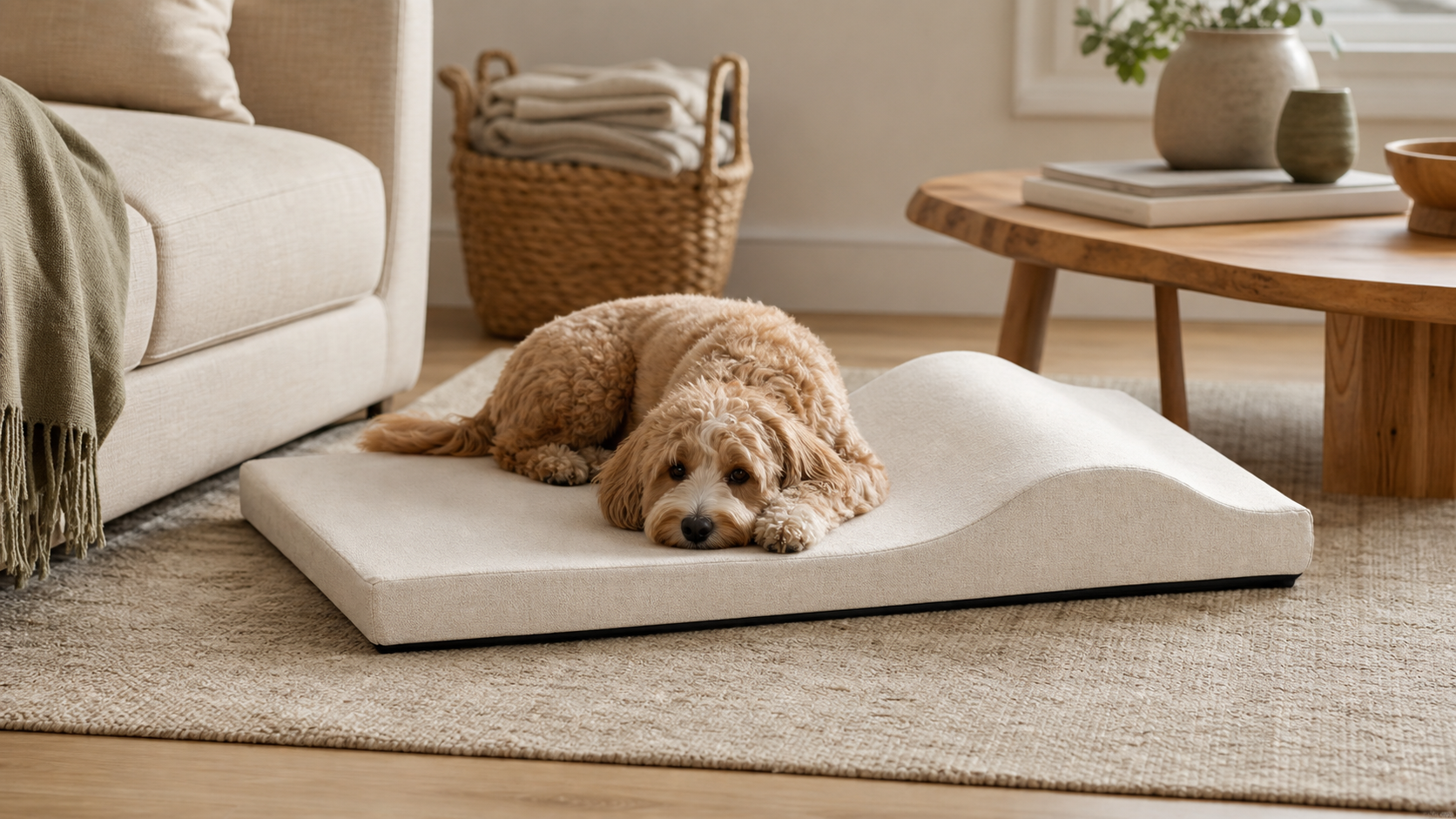
If you’ve searched for a high-quality dog bed, you’ve likely seen memory foam at the top of every list. Its reputation for comfort and support is well-earned, but as dog owners, we know that what works for us doesn't always translate perfectly to our pets.
To choose the best support for our pets, we need to look beyond the label and explore how memory foam aligns with the way dogs actually sleep, breathe, and rest.
Quick Reference: Memory Foam and Dog Beds
| Question | Short answer |
| Is memory foam good for dogs? | Conditionally. Useful for pressure relief, limited by heat retention and degradation |
| Does it help dog joints? | Short-term yes. Long-term depends on whether the foam holds its structure under dog usage |
| Is memory foam non-toxic? | Depends on the foam. Self-declared "non-toxic" is not the same as third-party verified |
| Main limitations for dogs | Traps body heat, degrades faster than human mattress use, core cannot be washed |
| What actually matters in a bed | Washable core, structural airflow, durable support, independent safety certification |
Why Memory Foam Became the Default for Dog Beds
Memory foam, technically called viscoelastic polyurethane foam, was first developed by NASA in 1966 to protect astronauts from the forces of launch and reentry. It entered the consumer market in the 1990s when Tempur-Pedic introduced the first commercial memory foam mattress, and the pet bedding industry began adopting it widely in the mid-2000s.
The transition into pet beds happened naturally.
As pet owners experienced the profound comfort of memory foam in their own beds, they wanted to share that same premium support with their dogs.
It made perfect sense: if a material is famous for relieving pressure on human joints, it seems like the ideal solution for canine joint care as well.
Because of its success in human mattresses, memory foam quickly became the undisputed standard for orthopedic dog beds. However, what rarely gets examined is whether the material's underlying logic actually transfers across species.
Memory foam's advantages were designed around very specific human conditions:
- a body temperature around 98.6°F
- primarily a back-sleeping position
- seven to eight hours of continuous sleep per night
Dogs operate differently on all three of those dimensions, which is what the next section addresses directly.
What Memory Foam Does Well, and Where It Falls Short
| Pros | Cons |
| Relieves Pressure: Distributes body weight to protect joints. | Traps Heat: Over-softens and overheats dogs. |
| Improves Comfort: Helps senior dogs sleep better and rise easier. | Sags Quickly: Foam cells break down and lose support from daily use. |
| - | Unwashable Core: Permanently absorbs moisture, oils, and odors. |
Benefits of the Memory Foam
Memory foam responds to pressure by slowly softening and distributing body weight across a larger surface area. In a new bed, this genuinely reduces concentrated load on bony points like hips, elbows, and shoulders.
For a senior dog transitioning from hard floor to a quality memory foam bed, the behavioral change is often visible: smoother rising, fewer sleep interruptions, less position-shifting overnight.
These benefits are real and worth acknowledging. But the more precise question is where it stops being reliable.
Three Limitations That Matter for Dogs
Heat Retention
Memory foam softens in response to body heat. At a human's 98.6°F, the softening is measured and controlled.
Dogs run between 100.5°F and 102.5°F (Cornell College of Veterinary Medicine), meaning the foam beneath them softens more than intended. Heavier contact zones sink further and trap more heat against the skin.
Unlike humans, dogs do not regulate heat through sweating across the body surface, so heat retention in a bed is not a minor comfort detail.
Support Duration
Memory foam's structure depends on intact foam cells. Those cells break down with compression and do not recover.
Dogs are polyphasic sleepers — most adult dogs sleep 8-13.5 hours per day (Sleep Foundation), averaging just under 11 hours, distributed across multiple rest periods and positions. This means a dog's bed accumulates far more compression cycles per year than a human mattress.
Localized collapse tends to appear first in the spots where a dog most frequently rests, which are also the spots that most need consistent support.
Washability
Memory foam cannot be machine washed. Water exposure damages the cell structure and leads to uneven drying. In practical terms, the core of a memory foam dog bed cannot be cleaned.
Only the cover can be washed. For a bed that absorbs skin oils, moisture, dander, and occasional accidents over months of daily use, that is not a minor limitation.
Is Memory Foam Non-Toxic for Dogs?
For most healthy adult dogs, a quality memory foam bed poses low health risk under normal use. The risk profile is higher for puppies, whose metabolic systems are less developed, and in conditions where the bed stays consistently damp, which can accelerate chemical release.
Standard memory foam is polyurethane-based, and its manufacturing process commonly involves additives including flame retardants, colorants, and plasticizers. The US EPA notes that polyurethane products emit volatile organic compounds (VOCs) during and after production.
A study published in Environmental Research (2022) measured VOC emissions from new memory foam mattresses over 32 days and identified multiple compounds present throughout the testing period.
How to Evaluate What You Are Actually Buying
The problem is not memory foam in general. The problem is that "non-toxic" and "chemical-free" on a pet product label are self-declarations with no required testing.
Two certifications offer actual third-party verification:
- OEKO-TEX Standard 100: Tests for 100+ harmful substances including heavy metals, formaldehyde, and pesticide residues. OEKO-TEX® STANDARD 100, designed for infant products with direct skin contact. Certification requires annual renewal by an independent laboratory.
- SGS food-contact safe: Tests whether materials release harmful compounds under contact conditions. Passing this means the material is assessed as safe even if a dog licks or chews the surface.
A product without either certification may still be safe. The point is that a label claim is not evidence.

What to Look For If You Are Reconsidering Memory Foam
If the limitations above have shifted how you are thinking about the category, the evaluation criteria for any bed become clearer.
Can the Core Be Washed, Not Just the Cover?
A removable, washable cover is standard. It is not a differentiating feature. The meaningful question is what happens when liquid reaches the core. If a product page only describes cover washing and says nothing about the core, assume the core cannot be cleaned.
Does the Structure Allow Continuous Airflow?
Cooling fabrics and gel layers provide a finite heat-absorbing effect that diminishes with use. A core structure that allows air to move through it continuously works differently. For a dog sleeping in multiple positions across many hours each day, structural airflow is the more relevant property.
Does the Support Hold Over Time?
Initial softness is not an indicator of long-term performance. Open-fiber structures that recover through fiber elasticity behave differently from foam cells that degrade irreversibly. Look for a manufacturer's guarantee on core shape retention over years, not just cover durability.
Is Safety Certification Independent?
As above: OEKO-TEX Standard 100 Class I or equivalent means an accredited third-party laboratory tested the materials. Self-declared claims mean nothing was verified externally.
See What a Different Approach Looks Like
Memory foam has real advantages in specific conditions. A dog's higher body temperature, polyphasic sleep pattern, and the need for a core that can actually be cleaned all work against those advantages in practice. The better question is not whether memory foam is good or bad in the abstract, but whether it fits what a dog bed genuinely has to handle.
Furizen's Zenest Ridge™ washable orthopedic dog bed is built around exactly that question. Instead of heat-trapping foam, it uses our proprietary ZephyrTech™ air-fiber core—delivering responsive, foam-free joint support in a structure you can literally rinse clean in the shower.
Curious about how a fully washable, breathable core actually looks and feels? See how the Zenest Ridge™ is put together.

FAQs about Memory Foam Dog Beds
Q1: Can My Dog Be Allergic to Memory Foam?
True allergies to polyurethane itself are uncommon. More often, what looks like a reaction near a dog's bed comes from dust mites, fungal spores, and bacteria that accumulate inside a core that cannot be fully cleaned or dried. If your dog shows skin redness, frequent scratching, or eye discharge near their bed, assess the bed's hygiene history before attributing the reaction to the foam material.
Q2: My Dog Has a Memory Foam Bed They Seem to Like. Should I Replace It?
Not necessarily right now. Press the center of the bed firmly for five seconds, then release. If it rebounds fully and evenly, support is still intact. Reconsider when you see localized flattening that does not recover, when your dog shows stiffness when rising from the bed, or when a persistent odor remains even after washing the cover.
Q3: Are There Dog Breeds That Benefit More From Memory Foam Than Others?
Breeds with high joint sensitivity get the most from consistent support quality, and also have the most to lose when that support degrades. Large breeds like Labradors, German Shepherds, and Bernese Mountain Dogs, and chondrodystrophic breeds like Dachshunds, Corgis, and French Bulldogs, fall into this category. For these dogs, how a bed performs at the one-year mark matters more than how it feels at purchase.
Q4: How Long Does Memory Foam in a Dog Bed Actually Last?
It depends on the dog's size and how many hours per day the bed is used. A practical indicator: press the center of the bed firmly for five seconds. Full, even rebound means the structure is holding. Slow or uneven rebound means cell breakdown has started. Degradation happens gradually, and most owners notice it later than it actually begins.
Sources
- Cornell University College of Veterinary Medicine (n.d.). Heatstroke: A Medical Emergency. vet.cornell.edu.
https://www.vet.cornell.edu/departments-centers-and-institutes/riney-canine-health-center/canine-health-information/heatstroke-medical-emergency - Sleep Foundation (2024). How Much Do Dogs Sleep? sleepfoundation.org. https://www.sleepfoundation.org/animals-and-sleep/how-much-do-dogs-sleep
- US EPA (2020). Potential Chemical Exposures from Spray Polyurethane Foam. epa.gov.
https://archive.epa.gov/epa/saferchoice/potential-chemical-exposures-spray-polyurethane-foam.html - Uwambayinema, F. et al. (2022). Evaluation of volatile organic compound emissions from memory foam mattresses. Environmental Research. PubMed ID: 35588879. https://pubmed.ncbi.nlm.nih.gov/35588879/
Share:
How to Choose a Washable Dog Bed That Looks Right in Your Home
Why Your Dog's Bed Smells and What You Can Do About It