

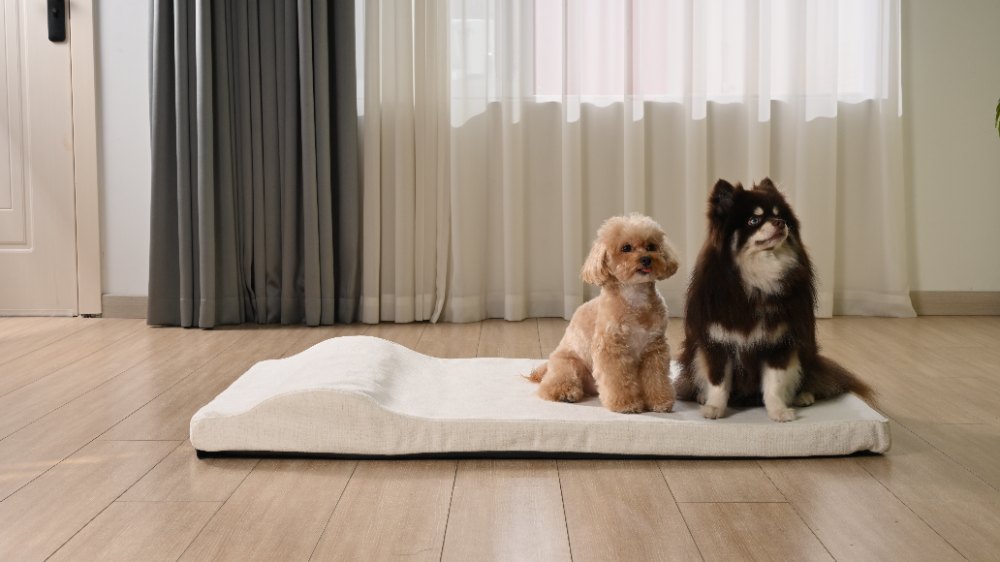
Dogs run 1–3°F warmer than humans, wear a full coat, and can barely sweat. When they sleep on a bed that holds heat instead of releasing it, the body responds the only way it can: shift positions, stretch flat, or abandon the bed for the tile. But how can you tell if they are sleeping too hot?
Key Takeaway
| What you're seeing | What it likely means |
| Shifts positions repeatedly through the night | Contact surface heats up; dog searches for a cooler spot |
| Leaves the bed for tile or hardwood | Floor pulls heat away faster than foam can |
| Lies flat, belly pressed to the surface | Maximizing body contact to shed heat |
| Light panting at rest or during sleep | Core temperature running too high to settle |
| Heads straight to the water bowl after waking | Mild overnight heat-related dehydration |
Dogs Run Hotter Than You Think
A healthy adult dog's normal body temperature is around 101–102°F (38.3–39.9°C). The human range sits around 97.7–99.5°F. That gap means a dog's body produces more heat at rest and has to work continuously to stay in a safe range.
This brings a big challenge: dogs have very few ways to release that heat.
How Dogs Lose Body Heat
| Method | How it works | Limitation during sleep |
| Panting | Evaporates moisture from the upper airway | Requires energy; mostly inactive at rest |
| Paw pad sweating | Small sweat glands in the paw pads only | Surface area too small to matter |
| Conduction through skin | Body heat transfers to a cooler contact surface | Entirely dependent on what they're lying on |
During sleep, panting is largely off. Conduction does almost all the work. The surface a dog sleeps on carries most of the thermal load, which is why material choice matters far more than most owners expect.
This applies all year. A heated home in January can sit at 72–74°F, comfortable for people, but a double-coated dog on a foam bed is in a very different situation. The season changes; the physics doesn't.
Breeds Most Affected
- Double-coated breeds (Golden Retrievers, Huskies, Shiba Inus, Border Collies): heavy insulation in both directions
- Flat-faced breeds (French Bulldogs, English Bulldogs, Pugs): restricted airways reduce panting efficiency
- Large breeds: more body mass, more heat output at rest
- Senior and overweight dogs: reduced thermoregulation capacity
How a Foam Bed Holds Heat Against Your Dog
Foam, particularly memory foam, was designed so it doesn't draw heat away from the body. For people, that's comfort. For dogs, it creates a heat trap. Three things are happening at the material level:
Dense structure blocks airflow. Conventional foam is built from a dense, closed-cell structure. When body heat transfers into the surface, it has no exit path. No convection, no exhaust.
- Memory foam absorbs and holds heat. Viscoelastic foam is temperature-sensitive by design. It softens under warmth, conforming to the body. The side effect: it actively retains the heat that caused the softening. Surface temperature climbs the longer a dog lies there.
- Synthetic covers seal the system. Most dog bed covers use nylon or polyester, both low-breathability materials. Combined with a dense foam core, the result is a layered thermal seal with no meaningful path for heat to escape.
Why Dogs Move to the Floor
When a dog gets up from a foam bed and lies on tile, the common read is "they needed to cool down," which is true. The more precise explanation: the foam had saturated with body heat, and tile's high thermal conductivity offered what the bed could not. Dogs make that calculation efficiently. This also explains why the behavior shows up in winter. Room temperature doesn't fix the problem when the heat source is the bed itself.

Five Signs Your Dog Is Sleeping Too Hot
1. Shifting Positions Through the Night
Body heat builds in one spot, the dog moves to a cooler section, and that section warms up too. The cycle repeats, and fragments sleep without an obvious cause.
2. Leaving the Bed for Tile or Hardwood
Tile and hardwood draw heat away from the body quickly. A dog that consistently prefers the floor over a soft bed is telling you the floor is cooler than the bed, even in winter.
3. Lying Flat With Belly Pressed to the Surface
Dogs use this posture to maximize skin-to-surface contact. It's the body accessing the most conductive area available. On a foam bed, it usually means the dog is trying to get the bed to do something the material isn't built for.
4. Light Panting at Rest or During Sleep
A resting dog in a comfortable room has no reason to pant. Mild panting with no apparent exertion points toward core temperature running higher than comfortable.
5. Going Straight to the Water Bowl After Waking
Sleeping hot causes mild fluid loss. A dog that consistently drinks noticeably right after waking may be compensating for overnight heat-related dehydration.
A note on other causes: Anxiety, pain, and illness can produce the same behaviors. If any of these appeared recently or come with other changes, a vet visit is the right first step. If they've been long-standing and ease up when the dog sleeps on a different surface, heat retention is the most likely cause.
Cooling Dog Beds: What Works and What Doesn't
What Doesn't Work (Even Though It Sounds Like It Should)
The market has several standard responses to the dog-heat problem. Most address the surface. None fix the structure.
Gel-infused foam creates an initial cool feeling by absorbing heat on contact. The catch: gel has a finite heat capacity. After 20–30 minutes of use it reaches thermal equilibrium with the body, the cool feeling disappears, and the base foam's heat-retention takes over. Fine for a short nap, not useful for a full night.
Perforated foam creates the appearance of airflow by punching holes in the material. Under bodyweight, those holes lose most of their airflow benefit. The perforations improve surface breathability when nothing is lying on the bed. They don't stay open under load.
Natural fiber covers (cotton, linen) are an upgrade from synthetic and worth having. But the cover sits at the surface. If the core is standard foam, heat accumulates before it ever reaches the cover. Cover breathability only helps once heat has already passed through the core, which foam is designed to slow.
What Actually Works
All three approaches above share the same ceiling: they patch foam's closed structure rather than replace it.
Real heat management during sleep requires a core that stays open under a dog's weight, in use, not just when the bed is empty. That means structural airflow. The bed's interior needs to keep air moving while a dog is actually lying on it, so heat exits continuously through convection rather than building up in a sealed space.
When the Core Itself Is Open
The Zenest Ridge™ from Furizen is built with ZephyrTech™ air-fiber, a 3D interwoven fiber network with open channels that remain open under bodyweight. Air moves through the core continuously, so heat exits through convection instead of accumulating in a sealed space. Unlike gel, which absorbs heat until it saturates, the fiber structure keeps working. The open core also rinses clean and air-dries in a few hours, versus the much longer drying time conventional foam typically needs, making regular cleaning realistic.

Give Your Dog a Cooler Night's Sleep
A dog's limited heat-loss options are a biological given. A bed that traps heat makes an already constrained situation worse, every night, all year. Gel and perforations patch the surface. Structural airflow addresses the actual problem. Before buying a bed, ask one question: does air still move through this when a dog is lying on it? If the answer is no, the bed is working against your dog's sleep from the first night.
FAQ about Dog Sleep Temperature and Comfort
Q1: What room temperature is comfortable for dogs to sleep in?
Most dogs sleep well at 65–72°F. Flat-faced breeds (French Bulldogs, Pugs, English Bulldogs) are more heat-sensitive; keeping their room at or below 68°F is a reasonable target. Double-coated breeds at or above 72°F need a sleep surface with good airflow to compensate.
Q2: Which breeds need the most airflow from their beds?
Three categories stand out: double-coated breeds (Goldens, Labs, Huskies, Shiba Inus, Border Collies) whose coats insulate in both directions; flat-faced breeds (French Bulldogs, English Bulldogs, Pugs, Boston Terriers) whose restricted airways reduce panting efficiency; and large breeds whose body mass generates more heat at rest. Short-haired small breeds like Chihuahuas and Dachshunds have relatively lower airflow needs.
Q3: Can sleeping hot affect a dog's health over time?
Yes. The effects run through sleep quality.
Fragmented sleep reduces time in deep sleep, where joint repair and immune maintenance happen.
Mild overnight dehydration from accumulated heat adds slow cumulative stress to kidney function.
Poor sleep also affects mood and cognitive sharpness over time.
Q4: Are cooling mats a good alternative to a breathable bed?
Not exactly. Cooling mats use pressure-activated gel or water-cooling to create a cold surface, which helps in high-heat situations. A breathable bed manages heat over a full sleep session, while also providing joint support.
If the choice is between one or the other, a breathable orthopedic bed handles both. A cooling mat works well as a supplement on hot days, not as a replacement for a well-structured sleep surface.
Share:
Dog Joint Support by Age: You're Starting Too Late (Here's the Real Timeline)
Dog Joint Support by Age: You're Starting Too Late (Here's the Real Timeline)