

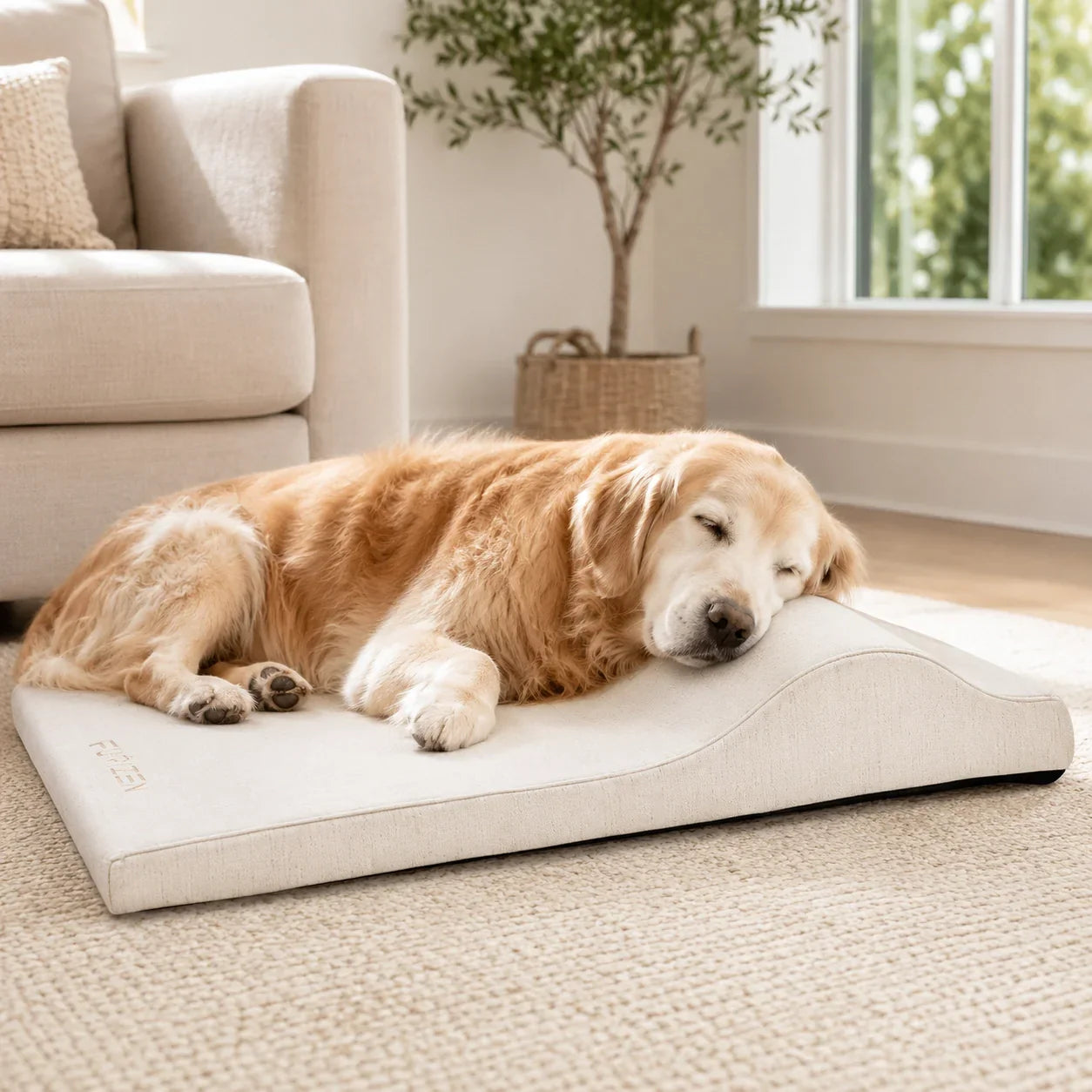
Your dog has started choosing the cold tile floor over their bed. Or they take three attempts to stand up in the morning. Or they sleep longer than they used to, but somehow seem less rested. These aren't random quirks. They're signals. Finding the right senior dog bed starts with knowing what to listen for.
Quick Reference: What Changes, What to Look For
| What Changes | Effect on Sleep | What Matters in a Bed |
|---|---|---|
| Joint cartilage wears down | Getting up and lying down becomes painful | Even pressure distribution, stable surface |
| Muscle mass decreases | Less cushioning over bones | Support that doesn't collapse over time |
| Body temperature regulation weakens | Overheats on dense foam, wakes frequently | Breathable, open structure |
| Sleep time increases | More hours in contact with the bed | Long-term support, not just initial comfort |
| Incontinence risk rises | Cover needs frequent washing | Easy-removal cover, washable core |
Is Your Senior Dog Trying to Tell You Something?
Dogs communicate discomfort through behavior, not words. Three patterns show up most often in senior dogs, and all three point to the same issue.
Moving to the floor.
A dog choosing cold tile over their bed is usually seeking two things: a cooler surface, or a firmer one. Dense foam traps heat. A bed that has softened over time can no longer provide a stable surface for getting up. The floor solves both problems. The bed doesn't.
Struggling to stand.
According to AAHA, you should "monitor your pet’s mobility and behavior to assess their pain".
A healthy standing motion is a single, fluid push. Repeated attempts, front legs bracing multiple times, pausing halfway through, are signs the surface isn't providing what the body needs to complete the movement.
Shifting positions during sleep.
Occasional repositioning is normal. Frequent repositioning, every hour or less, usually means the dog is avoiding pressure on a specific area. A bed with uneven support creates exactly this problem: soft spots push back unevenly, and the dog keeps adjusting to find relief.
When Does a Dog Become a Senior?
| Size | Weight Range | Senior Stage Begins |
|---|---|---|
| Small breeds | Under 20 lbs | 10–12 years |
| Medium breeds | 20–50 lbs | 8–10 years |
| Large breeds | 50–90 lbs | 8–9 years |
| Giant breeds | Over 90 lbs | 6–7 years |
According to Naomi D. Harvey from Canine Behaviour and Research Department, large and giant breeds age faster "due largely to an accelerated rate of growth between birth and adult size". A 7-year-old Labrador and a 7-year-old Chihuahua are at very different life stages.
These ages are starting points for paying attention, not automatic replacement dates. The behavioral signals in the previous section are the actual trigger.
Does "Orthopedic" Mean Anything on a Dog Bed?
Because there is no official industry standard for the word "orthopedic," beds with this label can vary widely in materials and design.
Rather than focusing just on the name, it is more helpful to look for three practical features that senior dogs actually need:
Does it distribute pressure evenly?
As dogs age and lose a bit of muscle, their bones sit closer to the surface. A truly supportive bed spreads their weight out evenly, taking the pressure off sensitive areas like hips, elbows, and shoulders.
Will it hold up over time?
Senior dogs can rest longer hours a day. Because they spend so much time resting, the bed needs to hold its shape well over time without sagging, ensuring they get consistent comfort day after day.
How hard is it to get up from?
While a super soft, plush bed looks cozy, sinking deeply into it can actually make it harder for an arthritic dog to get back up. A bed with a slightly firmer base gives their legs something solid to push off from, making wake-ups much easier.
What a Senior Dog Bed Actually Needs to Do
1. Long-Lasting Support
Prioritize long-term durability over initial feel. Fiber-based materials maintain their elasticity and spring back over time. In contrast, foam beds lose their support permanently once their air cells compress. This consistent support is critical for senior dogs sleeping substantially more during the day and nighttime (Animals, 2020).
2. Getting Up Without a Fight
Three design factors dictate how easily a senior dog can stand up:
- Firm Surface: A firm bed provides a stable push-off point, requiring significantly less joint effort than surfaces that compress deeply under paw pressure.
- Moderate Bed Height: Overly thick beds force arthritic joints through a wider, more painful range of motion to reach the floor.
- Low/Absent Front Bolster: A barrier-free entry prevents dogs from having to lift their legs over obstacles, though high side bolsters can still be used for security.
3. Breathability for Long Hours

Senior dogs sleep more hours during the day and nighttime. This prolonged use makes trapped heat a major issue. Beds must use open-fiber or fiber-based structures for essential airflow; closed-cell foam traps heat, which often causes dogs to abandon the bed for a cool floor.
4. Washability & Size Margin
- Washability: Research published in the Veterinary Journal reports that "prevalence of OA was 39.2%, 57.4%, 35.9% and 36.4% for the shoulder, elbow, hip and stifle, respectively" for dogs older than 8 years. Because arthritis impacts bladder and bowel control, the bed must be easy to wash at home and quick to dry to handle more frequent accidents.
- Generous Sizing: Always size up. Senior dogs shift frequently, so the bed should comfortably fit a fully stretched-out, side-sleeping dog with extra room to spare, preventing their legs from hanging off the edge.
Do Older Dogs Need a Firmer Bed?
Not harder. More stable.
These are not the same. A very hard surface provides a stable push-off point but no pressure relief for bony prominences. A very soft surface feels comfortable initially but creates the joint problems described above. Neither extreme serves an arthritic dog well.
The target is a surface that holds its shape under body weight without creating hard spots, distributes pressure across a broad contact area, and doesn't compress significantly under paw or leg pressure during the stand-up motion.
Think of the difference between sitting on a couch cushion that has lost its shape versus one that is still fully supported. Both are "soft." One keeps you stable. The other makes you work to get up. Senior dogs feel that difference on every waking.
What to Look for When You're Ready to Choose
Three questions cut through most of the noise.
Can the core be cleaned? Not just the cover. If liquid reaches the core and the core cannot be washed, the bed will hold bacteria and odor permanently. For senior dogs, core washability is a hygiene requirement.
How does the support material recover? Press the center of the bed firmly with your full hand for five seconds, then release. If it does not return to full height within ten seconds, the support is already compromised, or the material is not built to hold. Repeat in the corners. Corners fail first.
Is the entry point low enough? Have your dog approach the bed and observe. If they hesitate at the edge or step awkwardly, the entry is too high for their current mobility.
Meet the FURIZEN Zenest Ridge™
The Zenest Ridge™ Washable Orthopedic Dog Bed addresses the three functional standards above in a single structure.
Support that holds. The ZephyrTech™ air-fiber core uses woven open-fiber construction. Recovery comes from fiber elasticity, not air-cell compression. The core maintains its shape through years of use and hundreds of washes. The ZephyrTech™ air-fiber core is backed by a 10-Year Bounce-Back Warranty.
A surface dogs can push from. The ridge form provides a stable, even surface. The 6-inch profile keeps the floor accessible without requiring a large range of motion to stand. No front bolster means no obstacle at entry.
Built to breathe. ZephyrTech's open-fiber structure allows air to circulate through the entire core. Senior dogs don't wake up on a heat-trapped surface.
Fully washable, core included. The removable outer cover machine washes on a gentle cycle. The ZephyrTech™ core rinses clean under running water and dries in hours, not days, unlike memory foam that stays damp for days. For a senior dog with increased accident risk, this means the entire bed, not just the surface, can be cleaned and ready the same day.
Sizes for every dog:
- Medium: 36" × 23" × 6", fits standard 36" crates, recommended for dogs 7–40 lbs
- Large: 48" × 30" × 6", fits standard 48" crates, recommended for dogs 18–88 lbs
The Zenest Ridge™ comes with a 100-Night Sleep Trial and a 10-Year Bounce-Back Warranty on the ZephyrTech™ air-fiber core.
A Few Things That Help Beyond the Bed
- Add non-slip mats on hardwood and tile floors.
- Use a ramp instead of steps for access to furniture or the car.
- Keep the bed in the same location. Senior dogs with early cognitive changes rely on spatial memory.
- Keep the sleeping area away from floor drafts and AC vents.
- Switch to twice-yearly vet checkups.
- Ask your vet about Omega-3 supplementation.
- Keep a spare waterproof liner or washable blanket under the bed cover.
- Dim lights and reduce noise near the sleep area at night.
Frequently Asked Questions
Q1: At what age should I get my dog an orthopedic bed?
Look at behavior, not just age. Upgrade to an orthopedic bed when your dog starts struggling to stand, shifts positions frequently during sleep, or avoids their bed for cooler, firmer surfaces.
Q2: My senior dog has trouble getting on and off the bed. Ramp or new bed?
It depends on the obstacle. Use a gradual ramp for high furniture. If the dog bed itself is the issue—sinking too deeply or being too high to step out of—getting a new, firmer dog bed is the priority fix.
Q3: Should a senior dog with incontinence have a special bed?
Yes. A top-only waterproof cover is insufficient, as liquids can easily spill over the edges. You need a bed with a completely washable, quick-drying core.
Q4: My vet recommended joint supplements. Do I still need a better bed?
Yes, they solve different problems. Supplements reduce internal inflammation, while a supportive bed relieves external physical pressure during long hours of daily rest. Both are necessary to effectively reduce joint strain.
Sources
- AAHA. (2024). How to Assess Your Senior Pet's Quality of Life. American Animal Hospital Association. https://www.aaha.org/resources/how-to-assess-your-senior-pets-quality-of-life/
- PetMD. (2025). When Is a Dog Considered a Senior? PetMD. https://www.petmd.com/dog/general-health/when-is-a-dog-considered-senior
- Harvey, N. D. (2021). How Old Is My Dog? Identification of Rational Age Groupings in Pet Dogs Based Upon Normative Age-Linked Processes, Frontiers in Veterinary Science. https://www.frontiersin.org/journals/veterinary-science/articles/10.3389/fvets.2021.643085/full
- Kinsman, R., et al. (2020). Sleep Duration and Behaviours: A Descriptive Analysis of a Cohort of Dogs up to 12 Months of Age, PubMed Central. https://pmc.ncbi.nlm.nih.gov/articles/PMC7401528/
- Roitner, M., et al. (2024). Prevalence of osteoarthritis in the shoulder, elbow, hip and stifle joints of dogs older than 8 years, Vet J. https://pubmed.ncbi.nlm.nih.gov/38761958/
Share:
What a Waterproof Dog Bed Cover Actually Protects Against
Why Every Dog Owner Needs an Odor Resistant Dog Bed for a Fresher Home