

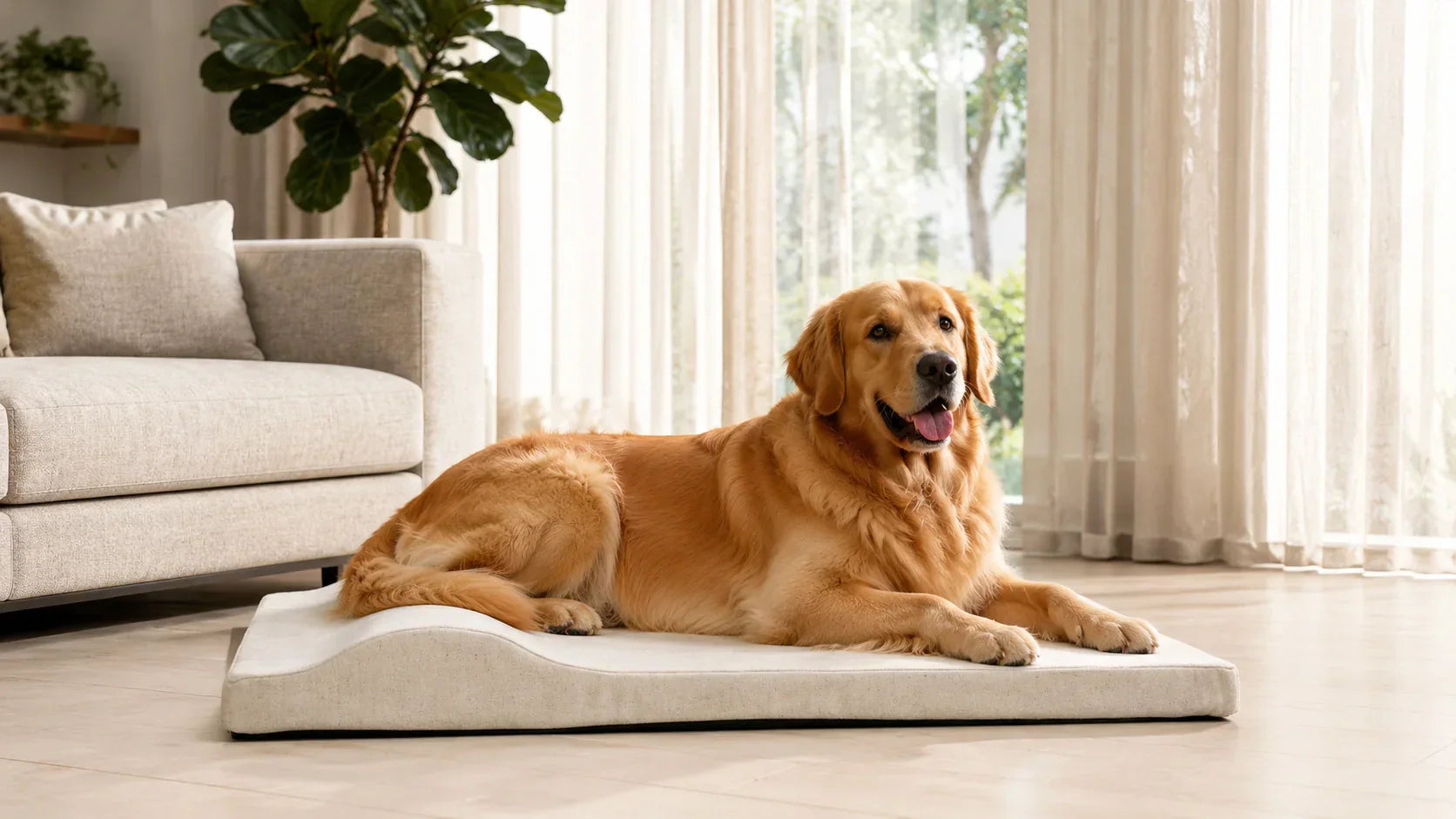
Your Golden Retriever has claimed the bathroom tile. Your German Shepherd is sprawled under the AC vent and hasn't moved in an hour. Large dogs with thick double coats are built for cold weather, not July. Here is what you need to know to keep them safe and cool all summer long.
Quick Reference
| Situation | Do This Now |
|---|---|
| Panting faster than usual, still alert | Move to shade or AC, offer small amounts of cool water |
| Gums turning red or pale, vomiting | Get to a vet immediately, apply cool water on the way |
| AC is on but dog still seems hot | Check the sleep surface. Foam beds trap heat even in cool rooms. |
| About to go for a walk | Do the pavement test first, stick to early morning or evening |
Which Large Dog Breeds Overheat Most Easily?
Why Do Large Dogs Overheat Faster?
Double-coat breeds and heavy-bodied dogs both struggle in heat. Their coats trap warmth efficiently, a larger body mass generates more heat than the body can easily release, and dogs rely on panting rather than sweating to cool down. That makes this heat buildup harder to offset quickly.
Common Large Breeds at Higher Risk
- Golden Retriever
- German Shepherd
- Labrador Retriever
- Siberian Husky
- Bernese Mountain Dog
- Great Pyrenees
- Chow Chow
- Saint Bernard
- Rottweiler
- Alaskan Malamute
Both Golden Retrievers and German Shepherds need the same level of summer care. Individual variation, age, and fitness matter more than breed differences alone (AKC, 2024).
How Do You Know If Your Dog Is Overheating?
Knowing the difference between early heat stress and a genuine emergency determines what you do next.
Early signs (handle at home):
- Panting faster than usual, tongue extended and flat
- Seeking cool floors or shade on their own
- Drinking more water than normal
- Mild lethargy or reluctance to move
- Excessive drooling
- Rapid heartbeat
- Dry or pale gums (early stage)
Emergency signs (get to a vet immediately):
- Gums turning brick red, pale, or white
- Vomiting or diarrhea
- Unable to stand, disoriented, or stumbling
- Body temperature above 104°F
- Seizures or collapse
- Loss of consciousness
The gum color check is the fastest field test. Healthy gums are pink and moist. Brick red, pale, or tacky gums mean the dog needs veterinary care, not just water (Petmd, 2025).
How Do I Cool Down My Large Dog Quickly?
Outdoors:
- Stop all activity and move to shade or AC immediately
- Apply cool (not cold) water to the belly, groin, paw pads, and neck
- Place a damp towel over the belly only and add a fan to speed evaporation
- Try the head-dunking method: research published in JAVMA found that dogs trained to submerge their heads in room-temperature water cooled down faster than with ice packs or wet towels alone (Otto et al., 2024)
- Offer water in small amounts: Provide frequent, small amounts of cool water rather than large gulps after exercise (Cornell University College of Veterinary Medicine).
- Keep windows open during any car ride to the vet
Indoors:
- Run AC or position a fan across a damp towel
- Guide your dog to bathroom tile or basement concrete. These surfaces draw heat away from the body.
- Offer a cooling mat as a short-term contact surface
- Offer frozen treats: low-sodium broth or plain yogurt frozen in ice cube trays helps cool from the inside
When Should You Call the Vet?
Call immediately if your dog shows any of these emergency signs:
- Gums turning brick red, pale, or white
- Vomiting or diarrhea
- Unable to stand, disoriented, or stumbling
- Body temperature above 104°F
- Seizures or collapse
Do not wait to see if things improve on their own.
Also call if:
- Home cooling has not produced visible improvement within 10 to 15 minutes
- Your dog has had heatstroke before. As recurrence risk is higher (AKC, 2024).
Call ahead so the clinic can prepare. Describe symptoms and how long they have been present.
If Your Dog Shows Signs of Heat Stroke: Step-by-Step Emergency Action
The following steps are based on publicly available guidance from Cornell University College of Veterinary Medicine, the American Kennel Club, and the AVMA. They are not a substitute for professional veterinary care. Contact your veterinarian or an emergency animal hospital immediately.
- Move the dog to shade or AC and stop all activity.
- Apply cool water to the belly, groin, neck, and paw pads. Do not use ice water.
- Add a fan to speed evaporation alongside the cool water.
- Offer small sips if the dog is conscious: Provide frequent, small amounts of cool water rather than large gulps.
- Monitor temperature if possible. Once it reaches 103°F, stop active cooling to avoid overcorrection.
- Go to the vet. These steps are first aid only. Internal complications may not appear immediately.
How Hot Is Too Hot for a Walk?
Do a quick pavement test before every walk: press the back of your hand flat on the pavement for 7 seconds. If you cannot hold it there comfortably, the surface is too hot for your dog's paws.
Temperature guide:
| Temperature | What to Do |
|---|---|
| Below 75°F | Normal activity for most large dogs |
| 75°F to 85°F | Reduce intensity and duration, watch closely |
| Above 85°F | Short bathroom breaks only, no exercise |
| Above 90°F | Keep large dogs indoors |
Humidity matters as much as temperature. Dogs cool by panting, which works through evaporation. High humidity slows that process. A humid 85°F is more dangerous than a dry 95°F for a panting dog.
Safest windows: before 7 AM and after 7 PM.
How Do I Prevent My Large Dog from Getting Too Hot Outside?
Timing and surfaces:
- Walk before 7 AM or after 7 PM when pavement has cooled
- Stick to grass, dirt paths, or shaded trails rather than asphalt or concrete
Hydration and activity:
- Carry a portable water bottle and collapsible bowl on every walk
- Keep outdoor sessions under 20 minutes when temperatures exceed 85°F
- Swimming and sprinkler play are among the most effective cooling methods for large dogs
Outdoor setup:
- Trees provide better shade than doghouses. Doghouses trap heat and restrict airflow.
- A tarp or canopy gives more reliable coverage than natural shade that shifts through the day
- A kiddie pool kept in the shade (not direct sun) gives dogs a place to self-regulate
How to Keep a Large Dog Cool Indoors and at Night

- Place multiple water bowls in different rooms, refreshed throughout the day
- Add ice cubes to bowls during peak afternoon heat
- Close curtains on sun-facing windows to slow indoor temperature rise
- Run a fan across a damp towel near the resting area
- Avoid carpet areas during hot periods. Carpet holds heat; tile and hardwood release it.
- Choose a breathable dog bed. A bed with an open-fiber core allows air to circulate through the material rather than trapping heat under the dog.
If your dog pants at night with the AC on: the sleep surface is often the cause. Dense foam compresses under body weight and traps heat at the contact point, even in a cool room.
Cooling Mistakes That Can Hurt Your Dog
Don't Use Ice Water or an Ice Bath
Cold water constricts surface blood vessels and slows heat release from the core. Use cool or lukewarm water only.
Don't Give Too Much Water at Once
Too much water too fast risks vomiting, bloating, and in large dogs, GDV. Offer small sips like 4 to 8 oz at a time with breaks in between.
Don't Shave a Double-Coat Breed
The double coat insulates against heat as well as cold. Shaving increases heatstroke and sunburn risk and can permanently damage coat regrowth. Dr. Jerry Klein, Chief Veterinary Officer at AKC, states shaving "eliminates that insulating layer... makes the dog susceptible to heat stroke" (AKC, 2026). Regular brushing to remove dead undercoat is the right approach.
Don't Cover the Whole Body With a Wet Towel
A full-body towel traps warm air rising from the skin. Cover the belly only, and pair with a fan.
Don't Assume the AC Is Enough
If a dog sleeps on dense foam, body heat accumulates at the contact surface regardless of room temperature. Check the sleep surface, not just the air temperature.
Never Leave Your Dog in a Parked Car
On an 85°F day, a car interior reaches 102°F within 10 minutes, even with windows cracked. There is no safe duration (Sandy City Government / Utah).
Does Your Dog's Bed Make the Heat Worse?
Most large dogs have already answered this question by moving to the tile floor.
Why Foam Beds Trap Heat
Dense foam compresses under body weight and stops air from moving through, so heat builds with nowhere to go.
Why Gel Cooling Mats Have Limits
The gel warms up within 20 to 30 minutes under a large dog and stops cooling once it reaches body temperature.

What to Look for in a Breathable Dog Bed
- Open-fiber or mesh core that allows air to pass through, not just around the material
- No sealed interior where heat and moisture can accumulate
- Washable core, not just a washable cover — foam cores hold odor and take 24 to 48 hours to dry
- Dries quickly after washing — slow-drying foam stays damp for days and creates conditions for bacterial growth
- Supportive enough for large breeds without compressing flat under body weight
Built Calm. Stays Breathable.
The FURIZEN Zenest Ridge™ Washable Orthopedic Dog Bed was built to solve one problem: the bed gets hot, and the dog moves to the floor.
The ZephyrTech™ air-fiber core uses an open-fiber woven structure. Air moves through the entire core rather than getting trapped. The surface stays breathable under a large dog's weight, all night.
The core rinses clean under running water and dries in hours, not days. The removable outer cover machine washes on a gentle cold cycle.
Sizes:
- Medium: 36" x 23" x 6", recommended for dogs 7-40 lbs
- Large: 48" x 30" x 6", recommended for dogs 18-88 lbs
Comes with a 100-Night Sleep Trial, Free Continental US Shipping, and a 10-Year Bounce-Back Warranty on the ZephyrTech™ air-fiber core.
Less fuss. More bond.
FAQs
Q1: What should I look for in a breathable dog bed for large breeds?
Look for an open-fiber or mesh core that allows air to move through the material. Gel mats cool on contact but warm up under a large dog within 20 to 30 minutes, while an open-fiber core keeps airflow moving through the night instead of trapping heat against the body.
Q2: Do I need to leave the AC on for my dog while I'm at work?
If budget is a concern, a frozen 2-liter water bottle placed near a fan, closed curtains on sun-facing windows, multiple bowls of ice water, and access to the coolest room (bathroom tile or basement) can keep most large dogs comfortable without running AC all day.
Q3: Can I shave my double-coat dog in summer?
No. The double coat insulates against heat as well as cold, and shaving increases heatstroke and sunburn risk while potentially causing permanent coat damage. Regular brushing to remove dead undercoat is the right approach.
Q4: At what temperature should I keep my dog indoors?
Above 85°F, limit outdoor time to short bathroom breaks; above 90°F, keep large dogs inside entirely.
Sources
- American Kennel Club. (2024). Heatstroke in Dogs: Signs, Symptoms, and Treatment. https://www.akc.org/expert-advice/health/heatstroke-in-dogs/
- PetMD. (2025). Dog Gum Colors and What They Mean. https://www.petmd.com/dog/general-health/dog-gum-colors-and-what-they-mean
- Parnes, S. C., et al. (2024). Voluntary head dunking after exercise-induced hyperthermia rapidly reduces core body temperature in dogs. Journal of the American Veterinary Medical Association, 262(12). https://avmajournals.avma.org/view/journals/javma/262/12/javma.24.06.0368.xml
- Cornell University College of Veterinary Medicine. (n.d.). Feeding Your Performance Dog. https://www.vet.cornell.edu/departments-centers-and-institutes/riney-canine-health-center/canine-health-topics/feeding-your-performance-dog
- American Kennel Club. (2026). Is It OK to Shave Your Dog? https://www.akc.org/expert-advice/health/is-it-ok-to-shave-your-dog/
- Sandy City Government, Utah. (n.d.). Summertime Heat Safety. https://sandy.utah.gov/171/Summertime-Heat
Share:
Choosing the Best Waterproof Dog Crate Pad for Durability and Comfort
Best Dog Bed for Heavy Chewers 2026: Durable and Tough