

Your dog flips, digs, and gnaws their bed into confetti, and you are tired of buying replacements every few months. A durable dog bed can break that cycle, but the label gets stuck on flimsy products that fail fast. The right pick combines tough materials, smart construction, and a little training. Here is what actually holds up for a heavy chewer, and why.
Quick Take
- No bed is fully chew-proof. Real durability comes from materials, construction, and daily management working together.
- Skip loose-fill beds. Stuffing gets gutted in minutes once a seam opens.
- Match the surface to the chewer. Elevated ballistic-nylon cots resist teeth best. Woven air-fiber holds shape and rinses clean for joint support.
- Manage the habit. Exercise, legal chew toys, supervision, and crate time lower the urge to chew the bed.
- FURIZEN's Zenest Ridge™ uses a one-piece air-fiber core with no loose stuffing to pull out, washes whole, and carries a 10-Year Bounce-Back Warranty on the ZephyrTech™ air-fiber core.
Why Do Heavy Chewers Destroy Most Dog Beds?
Chewing is normal canine behavior, not bad manners. Puppies teethe between 3 and 6 months of age, and adult dogs chew to relieve anxiety (ASPCA). A dog without enough exercise and stimulation finds an outlet, and the nearest soft object often loses.
Many beds were never engineered to survive that pressure once, let alone daily.
The failure points are predictable:
| Weak point | What happens |
| Loose poly or shredded-foam fill | One opened seam, and the dog pulls handfuls of stuffing out. Choking and blockage risk follows. |
| Thin single-stitched seams | Teeth and claws pop the threading, opening the core. |
| Exposed zippers | The zipper pull becomes a chew toy, then a gateway to the fill. |
| Low-density foam | Crumbles into swallowable pieces. |
| Decorative-only covers | Pretty fabric tears on first contact. |
A bed that survives a heavy chewer removes these weak points by design.
What Makes a Dog Bed Truly Durable?
Durability is engineering, not adjectives. A tough dog bed earns the word through a few specific traits.
Features that actually hold up:
- Tear-resistant cover fabric. High-denier ripstop or ballistic nylon beats soft decorative cloth.
- Reinforced, double-stitched seams. The seam fails first, so it needs the most attention.
- Hidden or guarded zippers. A zipper a dog cannot grab is a zipper a dog cannot open.
- A one-piece core. No loose fill means nothing to gut, even if the cover gets breached.
- Certified non-toxic materials. Any bed that gets mouthed daily should be safe to mouth. The OEKO-TEX Standard 100 label screens textiles for harmful substances (OEKO-TEX).
One honest note on the phrase "indestructible dog bed." A truly indestructible dog bed does not exist. The closest options resist damage and recover well, but a motivated chewer can wear down almost anything. The realistic goal is a bed that holds up to daily life, paired with a plan that lowers the urge to chew it.
Best Materials for Heavy Chewers: Air-Fiber vs Foam
Material choice decides most of the outcome.
| Material | Bite resistance | Joint support | Hygiene | Failure mode |
| Loose poly-fill | Very low | Low | Traps odor | Gutted once breached |
| Memory foam | Low to medium | High when intact | Cover-only washable | Crumbles into pieces |
| Ballistic-nylon cot | High | Firm, not cushioned | Wipes clean | Surface punctures over time |
| Woven air-fiber | Medium | High and even | Whole core rinses clean | Cover tears; core stays one piece |
Foam cushions well while intact, but a breached foam bed turns into crumbs. Moisture and trapped bed odor build inside the core permanently, a real problem for a chewer who also drools and digs.
Woven air-fiber takes a different route. The core is a single open-fiber structure, not a bag of filling, so there is nothing loose to extract. Water flows straight through, so the whole core rinses clean and dries fast.
It also cushions joints evenly, which suits a dog that rests 12 to 14 hours daily. For a chewer, the standout benefit is the failure mode: even a torn cover leaves an intact, washable core instead of a pile of swallowable stuffing.
Top Durable Dog Beds for Heavy Chewers
The best durable dog bed depends on what your dog does to bedding. Three categories cover most heavy chewers.
1. Elevated Chew-Resistant Cots
Tight ballistic nylon over a metal or PVC frame gives the most bite-resistant surface available. Great for outdoor use and teeth-first destroyers. The trade-off is comfort: the flat, firm surface offers little for aging joints.
2. Heavy-Duty Bolster Beds
A cushioned bed wrapped in high-denier nylon with guarded zippers blends comfort with toughness. Quality varies widely, so seams and zipper design matter as much as the fabric rating.
3. Woven Air-Fiber Orthopedic Beds
A one-piece air-fiber core delivers even support with no loose fill to pull out, plus whole-core washing for fast cleanup. A precise crate bed fit also stops the bed from sliding and bunching, which is what tempts many dogs to dig and chew at a loose edge in the first place.
How Can You Protect a Dog Bed From Chewing?

Even the toughest bed lasts longer when the urge to chew it drops. The fix starts with the cause, not the product.
Dr. Debra Horwitz, DVM, DACVB, a board-certified veterinary behaviorist writing for VCA Animal Hospitals, notes that "Determining the cause and motivation for chewing is essential in developing a treatment strategy." A bored chewer, an anxious chewer, and a teething puppy each need a different response.
A practical plan:
- Rule out medical and anxiety triggers. Sudden destruction, or chewing only at exits when home alone, may need a vet or behaviorist.
- Add exercise and enrichment. Walks, off-leash play, training games, and food puzzles drain the energy that fuels destruction (ASPCA).
- Offer legal chew outlets. Durable, size-appropriate toys give the jaws an allowed target.
- Manage the space. Confine your dog with a safe bed and toys until they have earned freedom.
- Skip after-the-fact punishment. Dogs do not connect a scold to an act minutes earlier. Redirect in the moment.
Pick a bed built around these habits, and the math shifts from "replace every season" to "replace the cover, maybe, in a few years."
FURIZEN Zenest Ridge™: A Durable, Washable Pick

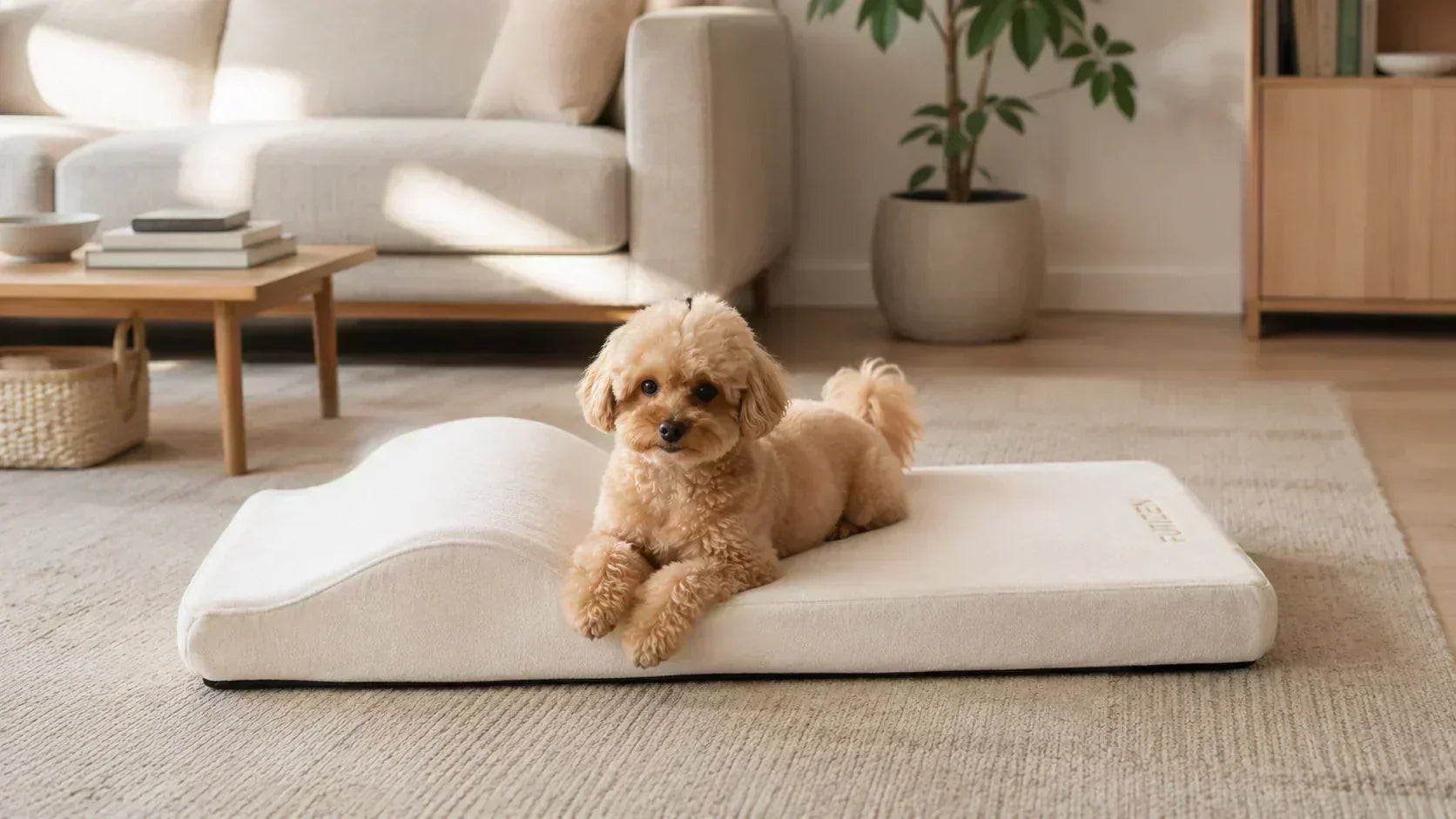
For cushioned joint support that also stands up to daily wear, the Zenest Ridge™ Washable Orthopedic Dog Bed is built for that balance.
The core is the story.
Its one-piece ZephyrTech™ air-fiber is a woven POE+PE blend that feels close to natural latex: soft, bouncy, no plastic texture. Because it is woven rather than stuffed, there is no loose filling for a chewer to drag across the floor.
Cleanup takes minutes.
The open-fiber build lets the entire core rinse clean under running water, not only the cover. Accidents, mud, and chewing messes wash straight through.
No loose fill — nothing for a chewer to pull out and swallow.
A straight answer on chewing: the Zenest Ridge™ is not sold as a chew-proof or indestructible dog bed, and no cushioned bed is. A teeth-first destroyer may still mark the soft cover, which is removable and replaceable. What the design does is erase the worst failure modes, the loose fill and trapped odor, while giving even orthopedic support a hard cot cannot. It's a way off the buy-and-toss cycle — less fuss over the bed, and more time with your dog.
Sizing for larger, stronger chewers is straightforward:
| Size | Fits | Recommended weight |
| Medium | Standard 36" crate | 7–40 lbs |
| Large | Standard 48" crate | 18–88 lbs (or two small dogs) |
The Zenest Ridge™ isn't designed to stand out. It's designed to belong, slipping into your 36" or 48" crate with no trimming and no gaps, then moving to the living room when crate days end.
Every bed ships with Free Continental US Shipping, a 100-Night Sleep Trial, and the 10-Year Bounce-Back Warranty on the core. If it is not the right fit after the first 30 nights, donate it to a local shelter and we issue a full refund.
Give Them a Bed That Lasts
Stop replacing shredded beds every season. Shop the Zenest Ridge™ Washable Orthopedic Dog Bed with Free Continental US Shipping, a 100-Night Sleep Trial, and a 10-Year Bounce-Back Warranty on the core.
Durable Dog Bed FAQs for Heavy Chewers
Q1: What breeds are the heaviest chewers?
Labrador Retrievers, German Shepherds, Belgian Malinois, Huskies, Pit Bull-type dogs, and Rottweilers chew the hardest. They combine high energy with strong jaws, and the Rottweiler and pit bull record the highest measured bite forces. Temperament varies within every breed, so any dog can be a heavy chewer.
Q2: Are there any truly indestructible dog beds?
No dog bed is fully indestructible. Elevated cots with ballistic nylon resist bites best, but a determined chewer can still wear them down over time. The realistic goal is durable construction (tough fabric, reinforced seams, no loose fill) paired with training and supervision.
Q3: Is a hard bed or soft bed better for heavy chewers?
It depends on the dog. Hard cots resist teeth but offer little joint cushioning. Soft beds support joints but chew more easily. The best middle path is a supportive core with no loose fill. Quick test: press the surface for 5 seconds. Good support springs back evenly.
Q4: How do you clean a durable dog bed after chewing?
Remove loose debris, then machine-wash the cover cold on a gentle cycle. If the core is washable air-fiber, rinse it under running water and stand it upright to air dry for about 24 hours. Never machine-wash or tumble-dry an air-fiber core.
Q5: Can heavy chewers destroy waterproof dog beds?
Yes. Waterproofing blocks liquids, not teeth. A strong chewer can still tear through coated or lined fabric. Treat waterproofing as protection against accidents and spills, and rely on tough fabric, reinforced seams, and a one-piece core for chew resistance.
Q6: What should I do if my dog destroys every bed I buy?
Find the cause first with a vet or behaviorist, since boredom, anxiety, and teething each need a different fix. Then add daily exercise and enrichment, confine your dog when unsupervised, and choose a bed with no loose fill and reinforced seams. For powerful chewers, try an elevated cot.
Q7: Are more expensive durable dog beds worth it?
Usually yes, on a cost-per-use basis. A cheap bed replaced several times a year often costs more over two years than one durable bed that lasts, especially with a long warranty and a replaceable cover.
Sources
- ASPCA (n.d.). Destructive Chewing. ASPCA. https://www.aspca.org/pet-care/dog-care/common-dog-behavior-issues/destructive-chewing
- ASPCA (n.d.). Position Statement on Dog Chews/Treats. ASPCA. https://www.aspca.org/about-us/aspca-policy-and-position-statements/position-statement-dog-chewstreats
- Horwitz, D. & Landsberg, G. (n.d.). Dogs and Destructive Chewing. VCA Animal Hospitals. https://vcahospitals.com/know-your-pet/dogs-and-destructive-chewing
- OEKO-TEX (2025). STANDARD 100 by OEKO-TEX. OEKO-TEX. https://www.oeko-tex.com/en/our-standards/oeko-tex-standard-100
Share:
How to Keep Large Dogs Cool in Summer (Golden Retriever, German Shepherd, and More)
Non-Toxic Dog Bed: Safe Materials for Puppies and Sensitive Dogs