

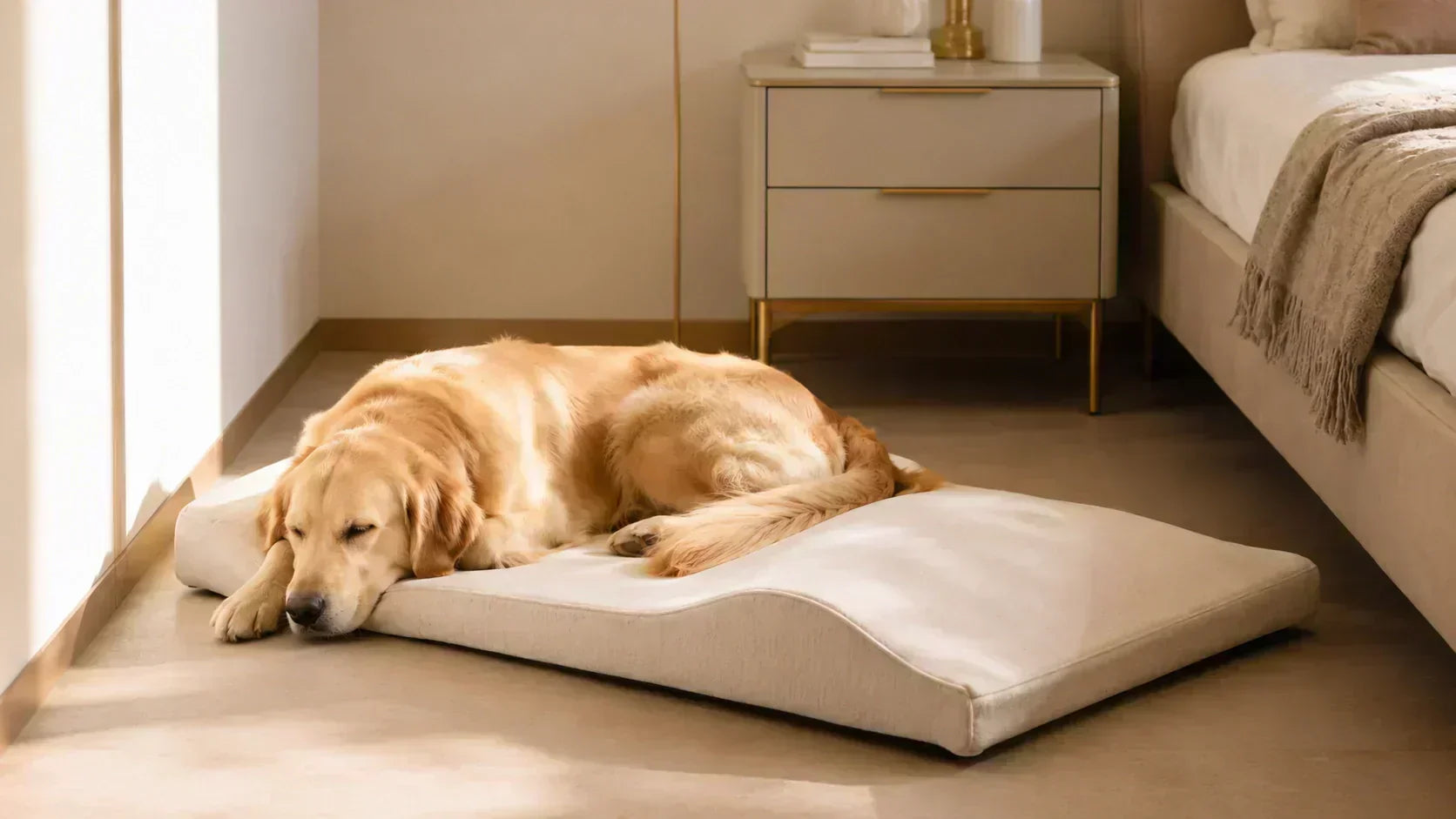
Puppies mouth everything, and dogs with sensitive skin react to things the rest of us never notice. The bed they sleep on for hours sits in close contact with both. A non-toxic dog bed lowers that daily exposure to off-gassing foam, flame retardants, and irritating dyes. Here is what makes a bed genuinely safe, which materials to trust, and how to spot the claims that do not hold up.
Quick Take
- Nothing is literally "chemical-free." Every material is made of chemicals. The real goal is a bed free of harmful, off-gassing, or allergenic additives, confirmed by certification.
- Skip the worst offenders. Cheap polyurethane foam can off-gas VOCs and often carries added flame retardants.
- Look for proof, not buzzwords. OEKO-TEX Standard 100 and food-contact testing beat vague "eco" or "natural" labels.
- Wash often. A bed whose whole core rinses clean removes allergens and dander instead of trapping them.
Why Do Puppies and Sensitive Dogs Need Non-Toxic Materials?

Two groups face the highest exposure from a bed: puppies and dogs with reactive skin. Both spend long hours in direct contact with the surface, and both have less protection against what that surface releases.
Dogs absorb what is in the home. A peer-reviewed study found flame retardants in the serum of pet dogs, with an average concentration of 1.8 ± 0.4 ng/g wet weight (Environmental Science & Technology). These compounds are added to furniture foam and migrate into household dust, which dogs pick up from the floor where they sleep.
Puppies take in more. They mouth and lick bedding, nap close to dust, and have developing organs and immune systems that are still maturing. A puppy also sleeps far longer than an adult dog, which stretches the hours of contact with whatever the bed releases. Lower exposure is a sensible precaution during these formative months.
Sensitive dogs are wired to react. Dr. Julia Miller, DVM, DACVD, a board-certified veterinary dermatologist, describes allergic dogs as "born with this predisposition to being overly sensitive to things in their environment." For these dogs, a cleaner sleeping surface removes one more trigger from the daily pile.
Contact allergy is part of that pile. According to VCA Animal Hospitals, wool or synthetics in bedding can act as contact allergens, with itching and irritation showing up at the contact points, usually the belly and paws (VCA Animal Hospitals). Most allergies surface after six months of age, so a young dog's reaction may appear only as the bed gets more use.
Common Chemicals Found in Regular Dog Beds
A budget bed can carry a surprising mix of additives. Here are the usual ones and why they matter.
| Chemical or material | Where it hides | The concern |
| Polyurethane / memory foam | The core | Off-gasses VOCs when new; can hold added flame retardants |
| Flame retardants (PBDEs, organophosphates) | Foam and fabric treatments | Migrate into dust; accumulate in dogs over time |
| PFAS stain and water repellents | "Waterproof" or stain-proof covers | Persistent compounds linked to health concerns |
| Azo and disperse dyes | Bright-colored covers | Possible skin irritants for sensitive dogs |
| Formaldehyde-based finishes | Wrinkle-resistant fabric | Known contact irritant and off-gasser |
The foam itself is the biggest variable. Furnishings are a recognized source of indoor VOCs, and the EPA notes that indoor VOC levels run up to ten times higher than outdoor air (US EPA). A new foam bed with a strong chemical smell is releasing some of those compounds into the room your dog breathes.
What Makes a Dog Bed Truly Non-Toxic
The word "non-toxic" means little on its own. Certifications turn it into something you can verify.
| Certification | What it verifies |
| OEKO-TEX Standard 100 | Tests textiles for harmful substances; Class I is the strictest tier, used for baby and infant products |
| GREENGUARD Gold | Confirms low chemical emissions into indoor air |
| CertiPUR-US | Applies to foam made without certain flame retardants, with low VOC emissions |
| SGS food-contact safe | Independent testing that the material is safe at the level of food contact |
A genuinely non-toxic dog bed pairs proof like this with smart material choices: no added flame retardants, low or zero VOC output, undyed or low-impact dyes, and a structure you can actually clean. Bonded foam beds add one more hidden ingredient, the adhesives that glue scrap foam together, which are worth avoiding for a sensitive dog. That last point about cleaning matters because safety is ongoing. A bed you can wash deeply keeps removing dander, dust, dried saliva, and allergens instead of letting them settle into a core you can never reach.
Best Non-Toxic Dog Beds for Puppies and Sensitive Skin
The safest bed for your dog depends on coat, skin, and how messy life gets. Three categories cover most homes.
1. Certified Natural-Fiber Beds
Covers in organic cotton or wool over a natural fill feel reassuring, and certified versions skip harsh dyes and finishes. Watch one catch: wool is itself a contact allergen for some dogs, so it suits skin-sensitive pets only after a careful trial.
2. Certified Low-Emission Foam
Foam carrying a CertiPUR-US or GREENGUARD Gold mark is a real step up from uncertified foam. It still has the foam drawbacks, though: only the cover washes, while moisture and allergens build inside the core over time.
3. Washable Air-Fiber Beds
A woven air-fiber core skips polyurethane foam entirely, so it sidesteps the foam off-gassing and flame-retardant questions. The whole core rinses clean, and there is no loose fill for a puppy to pull out and swallow. During crate training, when a young dog rests against the surface for long stretches, that combination of clean materials and easy washing earns its keep.
How Can You Tell If a Dog Bed Is Actually Safe?
Marketing leans hard on soft words like "eco," "natural," and "pet-safe" that no one has to prove. Run any bed through this short list instead.
- Demand named certifications. Look for OEKO-TEX, GREENGUARD Gold, CertiPUR-US, or food-contact testing by name, not a vague green leaf icon.
- Find out what is inside. Foam, loose poly-fill, or woven fiber behave very differently. A brand that hides the core material is telling you something.
- Use the sniff test. Unbox the bed and smell it. A strong chemical odor signals active off-gassing. Air it out, and treat a smell that lingers for days as a red flag.
- Watch your dog. A pet that paws at a new bed, refuses to settle, or starts scratching after a switch may be reacting to it. Behavior is data.
- Check washability. A bed you can clean to the core stays safer over months of dander and dust than one you can only spot-clean.
FURIZEN Zenest Ridge™: A Non-Toxic Dog Bed Review
For owners who want to skip the foam guesswork, the Zenest Ridge™ Washable Orthopedic Dog Bed is built around exactly that priority.
No foam, by design. The core is ZephyrTech™ air-fiber, a woven POE+PE blend with zero plastic texture and no chemical odor. With no polyurethane foam in the bed, the off-gassing and flame-retardant concerns that follow cheap foam beds do not apply.
A straight word: no bed is literally "chemical-free" — air-fiber is a synthetic material, not a plant. What matters is what it isn't: no polyurethane foam, so the off-gassing and flame-retardant questions that come with cheap foam don't apply here.
Cleanliness you can keep up. The open-fiber core lets water flow straight through, so the whole core rinses clean, not only the cover. That flushes out trapped allergens and odor instead of letting them build inside, which foam beds cannot do. With no loose fill, there is nothing for a curious puppy to pull out and swallow.
The Zenest Ridge™ isn't designed to stand out. It's designed to belong that slips into your crate and moves to the living room when crate days end.
Sizes cover small dogs through large breeds:
| Size | Fits | Recommended weight |
| Medium | Standard 36" crate | 7–40 lbs |
| Large | Standard 48" crate | 18–88 lbs (or two small dogs) |
Every bed ships with Free Continental US Shipping, a 100-Night Sleep Trial, and a 10-Year Bounce-Back Warranty on the ZephyrTech core.
Frequently Asked Questions About Non-Toxic Dog Beds
Q1: Are all memory foam dog beds toxic?
No. Memory foam is not automatically toxic, but uncertified foam can off-gas VOCs when new and may contain added flame retardants. Foam carrying a CertiPUR-US or GREENGUARD Gold mark is tested for low emissions and restricted chemicals. If a foam bed has a strong, lasting chemical smell, air it out and treat that odor as a warning sign.
Q2: What certifications should I look for in a non-toxic dog bed?
Look for OEKO-TEX Standard 100 (Class I is the strictest, used for infant products), GREENGUARD Gold for low emissions, CertiPUR-US for safer foam, and SGS food-contact testing. A named certification you can verify beats vague labels like "eco," "natural," or "pet-safe," which no one has to prove.
Q3: Is a non-toxic bed necessary for puppies?
It is a smart precaution. Puppies mouth and lick bedding, sleep close to floor dust, and have developing systems, so lowering their chemical exposure makes sense. Dogs already accumulate household flame retardants at several times human levels, and a certified, washable bed is one easy way to reduce what they take in.
Q4: Can sensitive dogs be allergic to regular dog beds?
Yes. Contact allergy can come from materials in bedding, such as wool or synthetic fabrics, plus dyes and laundry residues. Signs show up as itching and irritation at contact points, usually the belly and paws. Switching to a certified, low-dye, washable bed and using fragrance-free detergent often helps. See your vet if symptoms persist.
Q5: How do I know if my current dog bed is safe?
Check three things. First, look for a named safety certification on the label or product page. Second, find out what the core is made of, since hidden foam is a common gap. Third, use your nose: a persistent chemical smell points to off-gassing. A bed you can wash to the core also stays safer over time.
Q6: Are expensive dog beds always safer?
No. Price alone proves nothing. Some costly beds still use uncertified foam, while some affordable ones carry real certifications. Judge safety by verified testing, the core material, and washability, not by the price tag.
Sources
- US EPA. (n.d.). Volatile Organic Compounds' Impact on Indoor Air Quality. U.S. Environmental Protection Agency. https://www.epa.gov/indoor-air-quality-iaq/volatile-organic-compounds-impact-indoor-air-quality
- Venier, M. & Hites, R. A. (2011). Flame Retardants in the Serum of Pet Dogs and in Their Food. Environmental Science & Technology. https://pubs.acs.org/doi/abs/10.1021/es1043529
- Barnette, C. & Ward, E. (n.d.). Allergies in Dogs. VCA Animal Hospitals. https://vcahospitals.com/know-your-pet/allergy-general-in-dogs
- Burke, J. (2022). The Nuts and Bolts of Canine Atopic Dermatitis. dvm360. https://www.dvm360.com/view/the-nuts-and-bolts-of-canine-atopic-dermatitis
- OEKO-TEX (2025). STANDARD 100 by OEKO-TEX. OEKO-TEX. https://www.oeko-tex.com/en/our-standards/oeko-tex-standard-100
Share:
Best Dog Bed for Heavy Chewers 2026: Durable and Tough